BMW M2 F87: original M2 versus Competition versus CS
BMW M2 F87: original M2 versus Competition versus CS
By BidBud · October 26, 2026
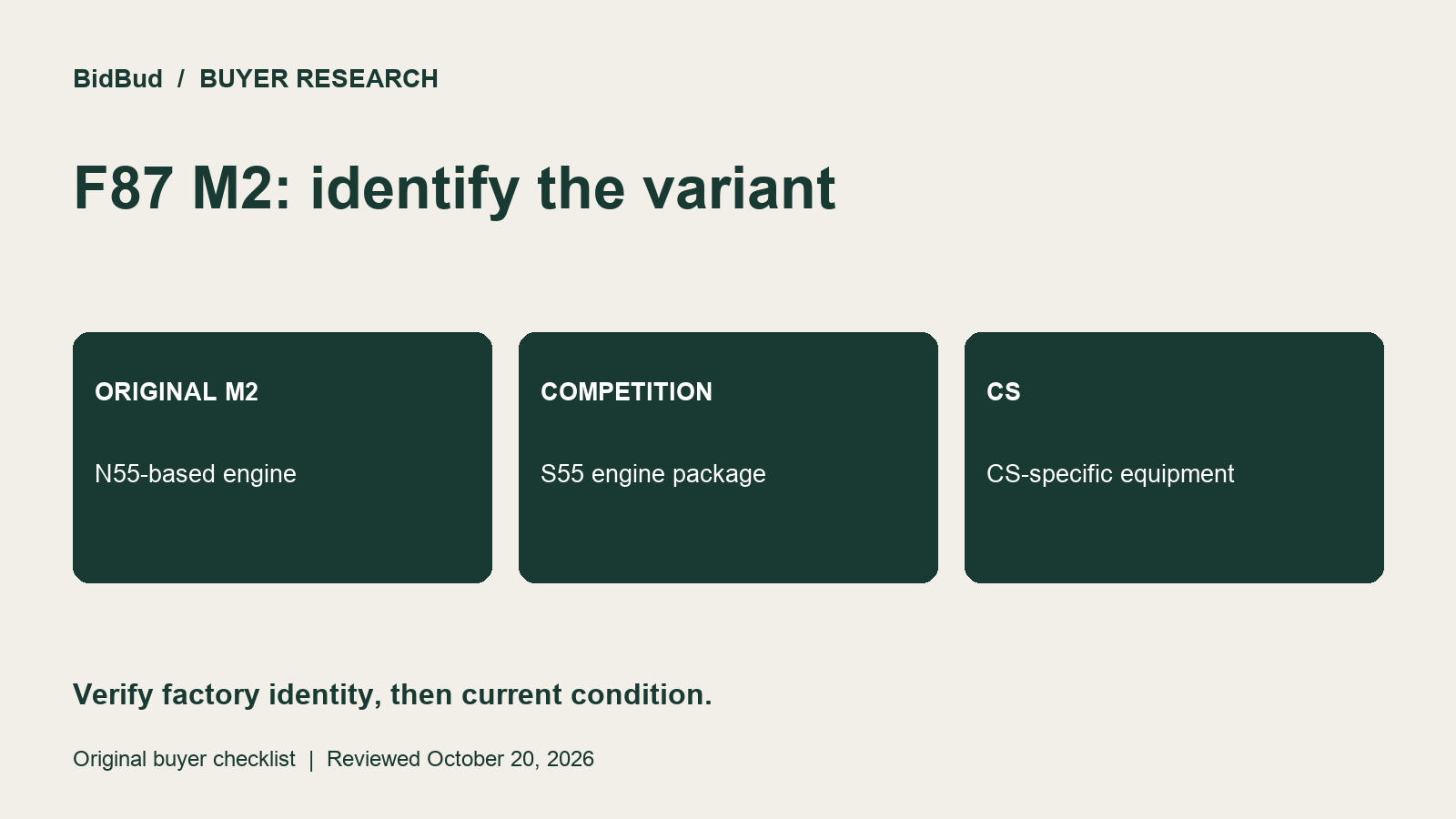
Start an F87 M2 shortlist with the factory variant, then check the individual car. The original M2, M2 Competition and M2 CS are different configurations within the same generation. A badge, set of wheels or carbon-fiber accessory does not establish which version a car left the factory as.
This guide uses North American manufacturer material to organize a listing check. Ratings below retain the source’s horsepower units; do not substitute European PS figures or apply these equipment descriptions to every market without checking local documentation.
The three factory starting points
Original M2: BMW Canada’s 2016 launch release describes a 3.0-liter turbocharged six rated at 365 hp, with a six-speed manual or optional seven-speed M DCT. Specialist Kies Motorsports identifies the original car’s engine as N55-based and distinguishes it from the Competition’s S55.
M2 Competition: BMW’s US 2019 model announcement identifies the S55 engine at 405 hp, revised cooling, larger brakes and M Sport seats. The model name signals a broader mechanical package; it is not simply a cosmetic Competition badge added to the original M2.
M2 CS: BMW’s 2020 US announcement lists an S55 rated at 444 hp, standard Adaptive M suspension, and carbon-fiber-reinforced plastic roof and hood. The release labels its specifications preliminary. It lists carbon-ceramic brakes as optional, so their absence alone does not disqualify a claimed CS.
Treat these as reference points for records and inspection, not a visual authentication service. A car may have changed substantially since delivery.
Read a listing in three passes
Pass one: factory identity. Request the build record or original window sticker and compare it with the advertised variant and model year. Keep the production date, model year and first registration date separate. If the paperwork does not resolve the variant, ask for clarification before building a price comparison around it.
Pass two: present specification. Compare the documented factory equipment with the engine, cooling hardware, seats, brakes, suspension and body components currently shown. Write down both confirmed changes and gaps in the evidence. A seller’s claim that parts are “CS-style” should remain a parts description, not become the car’s factory identity.
Pass three: condition and history. Have a specialist assess the actual car. Kies’s F87 guidance emphasizes tune history, cooling, brake and tire condition, and track-use evidence. These are inspection topics, not grounds to diagnose a defect from a photograph or assume every modified car has been abused.
What three auction descriptions teach
A 2018 M2 on Cars & Bids is described with an N55 engine and six-speed manual. Its equipment list includes M Performance exhaust and carbon-fiber exterior pieces. Those accessories do not turn an original M2 into a Competition or CS.
BaT lot 224701 describes a 2020 Competition with an S55 and seven-speed M DCT. BaT lot 232477 describes a 2020 CS with a six-speed manual and optional carbon-ceramic brakes, and references its window sticker.
These examples show which fields to verify. They are not a matched price study: the variants, equipment, dates and individual circumstances differ. The Competition auction is marked reserve not met, while the CS auction reports a sale. Combining those visible results would introduce an outcome error before any variant comparison began.
Use a variant-confirmation worksheet
For each car, record:
- Advertised variant and the document supporting its factory identity.
- Original sales market, model year and production date where available.
- Engine family and evidence of current hardware or software changes.
- Gearbox type, brake configuration and suspension specification.
- Exterior and cabin equipment: factory, later addition or unresolved.
- Service records, inspection findings and missing evidence.
- Your reason for keeping the car on the shortlist.
Then decide which variant actually fits your use. If you are willing to buy more than one, keep separate shortlists and budgets. Do not translate a horsepower difference into a price multiplier or assume a rarer badge guarantees a better individual car.
Use BidBud’s BMW research hub to organize the wider search. BidBud supports research and budget planning; it does not certify factory identity or place bids.
Research checked October 26, 2026. Auction descriptions are attributed examples, not independently authenticated vehicles. This guide makes no current-price, investment-return or reliability-rate claim.