BMW M3 E36: US versus European specification comparables
BMW M3 E36: US versus European specification comparables
By BidBud · October 16, 2026
“E36 M3” is not a complete comparable-car description. A US-specification example and a European-specification car can share a model name while differing in original mechanical specification. Equally, a car advertised as Euro-spec may be located in the United States or may have first been sold in Japan.
Keep original specification, current configuration and sale location in separate fields. This guide explains how to build that identity record before treating an auction result as relevant to the car you want. It does not calculate a European-specification premium.
Start with manufacturer history
BMW’s US M3 historical overview, within its 2002 press documentation, describes the US E36 M3’s 3.0-liter, 240-horsepower engine for 1995 and its move to 3.2 liters for 1996. BMW Group Classic’s US coupe entry also distinguishes the US versions from the ECE cars.
The specialist-run BMW M Registry keeps separate 3.0-liter and 3.2-liter model catalogs. Use a model catalog to organize questions about a claimed configuration, then verify the individual car with its records and an inspection. A catalog entry cannot authenticate an engine swap.
That is enough to reject a single undifferentiated “E36 M3 engine” assumption. It is not enough to identify the engine currently installed in an individual auction car. Request its original specification records and documentation of any subsequent changes.
Do not convert a horsepower difference into a price multiplier. Ratings, units, condition, originality, equipment and sale circumstances are separate questions. This page deliberately avoids a performance-based valuation formula.
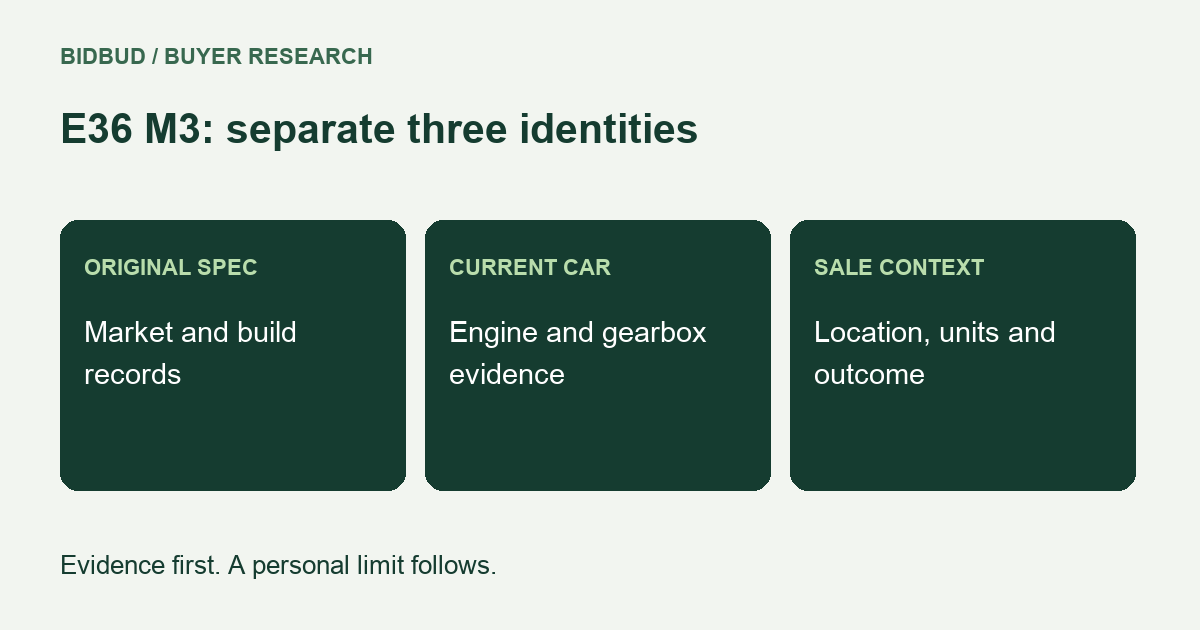
Record three identities for every candidate
Original identity: original sales-market specification, production information supported by records, body style, steering position, engine and transmission as delivered, and any documented special edition. A badge or fitted trim piece does not independently establish those facts.
Current configuration: the installed engine and gearbox, known swaps or conversions, supporting workshop records and unresolved discrepancies. If the seller describes an engine replacement, ask what was installed and when, rather than assuming “replacement engine” means an identical original specification.
Sale context: current country, stated currency, auction date, explicit sold or unsold outcome, mileage unit and documentation available for the buyer’s intended use. Sale location belongs here; it should not overwrite original specification.
Keep the seller’s claim and the supporting evidence adjacent in your notes. For example: “European specification, according to listing; build documentation requested.” Upgrade the classification only when the evidence supports it.
A real listing separates specification from geography
Bring a Trailer’s 1996 M3 coupe, lot 173,896, describes a left-hand-drive European-specification car initially sold in Japan and later imported to the US. The listing identifies an S50B32 engine, a six-speed manual and an odometer reading in kilometers.
This is a concrete example of why “Japanese-market history,” “European specification” and “currently in the US” need separate fields. It is the listing’s account of that car, not a rule that every Japanese-market M3 has the same specification. The article does not independently certify its engine identity, documentation or present condition.
For a potential purchase, ask a qualified BMW specialist to reconcile the original records, installed components and service history. Keep the original odometer unit even if you add a clearly labeled conversion for comparison. Do not silently turn a kilometer reading into miles or treat a changed instrument cluster as a verified lifetime reading.
Keep special editions out of an ordinary-car average
BMW’s E36 M3 GT history describes the GT and discusses the US Lightweight separately. These names are not interchangeable labels for an ordinary M3 with cosmetic modifications.
If a seller claims a special edition, request the documentation that supports it and keep that car in its own comparison group until the identity is resolved. Parts associated with a special edition can appear on another car without changing its factory identity. Conversely, a genuinely documented edition should not be silently averaged with standard cars simply because the generation matches.
A worked comparison decision
Imagine your target is a documented US-specification E36 coupe with its original type of drivetrain. You find three hypothetical results: A is another US-spec coupe with similar use and sufficient history; B is a European-spec coupe sold in the US; C began as a US-spec car but now has a documented engine and gearbox swap.
A can enter the core comparison after you review condition and the sale outcome. B is an alternative specification. C belongs in a modified-car group, with its work and inspection evidence evaluated separately. The fact that all three sold in the same country does not remove those distinctions.
If your target is instead a European-spec car, rebuild the core group around that target. Preserve the distinction between original specification and later modifications. Do not solve a shortage of close comparables by dropping those fields and reporting a more precise-looking average.
Use a short evidence worksheet
For each candidate, save these entries:
- Source URL, sale date, outcome and currency.
- Original sales-market specification and the record supporting it.
- Body style, steering position and documented edition or package.
- Original drivetrain versus installed drivetrain, including known changes.
- Odometer reading, original unit and any documented instrument change.
- Condition, modifications, service evidence and questions still open.
- Reason to include it in the core group, retain it as an alternative or exclude it.
Request import and registration documents where relevant, and verify requirements with the appropriate authorities for your intended jurisdiction. This worksheet does not determine import eligibility or registration compliance. Resolve those questions before treating the car as a usable alternative.
The M3 generation guide can help organize broader research. BidBud’s buyer workflow supports auction research and personal budget planning; it does not certify vehicle identity or place bids.
Research note: Reviewed October 16, 2026. The three-car comparison is hypothetical. No price premium, import-eligibility determination or numerical valuation is asserted.