BMW M5 E39: original paint claims and documentation
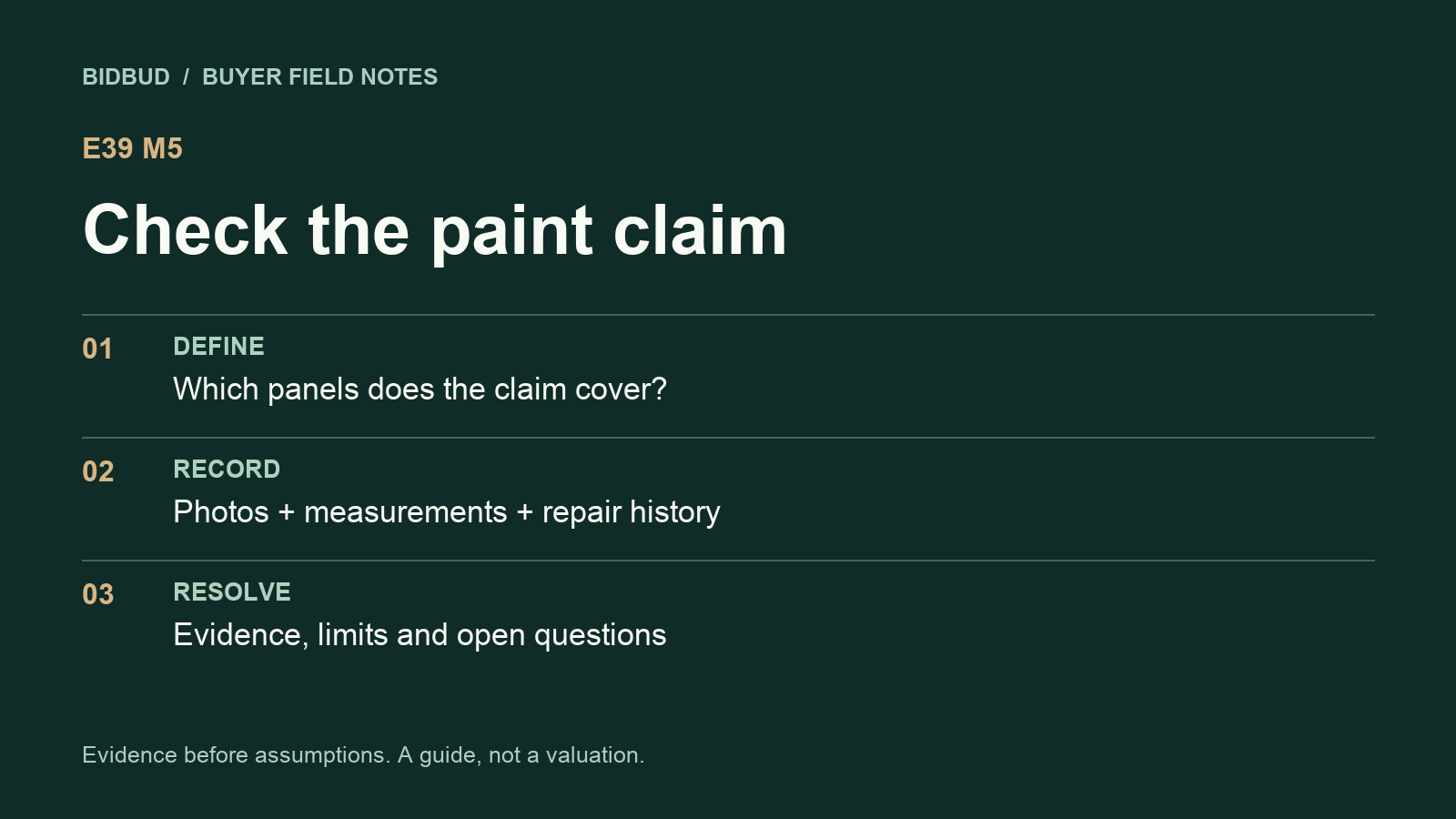
BMW M5 E39: original paint claims and documentation
By BidBud · Research checked November 23, 2026
“Original paint” needs a scope. Does the seller mean every exterior surface, the metal body panels, or simply that they have not commissioned paintwork during their ownership? On an E39 M5, a useful review connects that claim to panel-level observations, available repair records and a qualified inspection. A glossy photograph or a clean history report is not the same evidence.
The aim is to understand the car's finish and documented repairs before bidding. This guide does not assign a repaint discount or claim that a particular paint reading proves factory originality.
Separate color, finish history and repair history
Start a record with three distinct questions: what color was specified when the car was built, what paintwork is disclosed, and what physical repairs are documented? A factory color code can help identify the intended color. It does not prove that the current coating was applied at the factory.
Ask the seller to clarify which panels the originality statement covers and how they know. Preserve an ownership-limited statement as such. “No paintwork during my ownership” leaves earlier periods unanswered; it should not become “never painted” in your comparison notes.
Also distinguish a refinished surface from a replaced panel. Both deserve documentation, but they are different claims. Ask for the reason, approximate date, repairer and available before-and-after records without assuming that every refinish followed a collision.
An E39 listing shows why a clean report does not settle the question
The 2002 M5 in BaT lot 222764 was offered with a clean Carfax report while its description disclosed a replaced front bumper cover, a refinished hood and touch-ups on forward-facing surfaces. Those statements can coexist. The listing's finish disclosures answer a different question from the history-report label.
This is a documentation example, not an independent assessment of that car. It suggests a practical reading order: exterior description, close-up photographs, available repair records, history report and inspection findings. Do not stop at whichever item gives the most reassuring answer.
Request a panel record rather than a single reassuring reading
Give the inspector a simple record to complete for the hood, roof, trunk lid, each fender, each door and each rear quarter. Record bumper covers and other trim separately. For every area, ask for:
- A dated overview and close-up photograph, identifying the panel and side of the car.
- Visible observations, including any mismatch, overspray, edge detail or repair evidence the inspector considers relevant.
- Thickness measurements where the instrument and surface are suitable, with locations, units and instrument identification.
- A conclusion with limits: what the evidence supports, what remains uncertain and whether specialist body inspection is needed.
Ask the operator to follow the instrument manufacturer's procedures and explain any unmeasured areas. A blank cell should mean “not measured,” with a reason; it should not be silently treated as a normal result.
Understand what the gauge can and cannot answer
DeFelsko's automotive inspection guidance explains that different measurement technologies apply to different substrates. The appropriate equipment for metal panels is not automatically appropriate for plastic or composite surfaces. Ask what the instrument measures and whether its readings are valid on the surface under examination.
The manufacturer's detailing guidance also says there is no single correct thickness for every vehicle and surface. Do not take a generic internet range and turn it into a pass/fail threshold for an E39 M5. Interpretation belongs with the surface, the instrument, the pattern of readings and the physical inspection.
Our suggested record keeps observations separate from conclusions. A measurement can prompt a question about a panel; it does not by itself explain when or why work happened. Likewise, uncertainty about a coating should not become an unsupported allegation about structural damage. Request the appropriate further inspection when the available evidence cannot settle a material concern.
Use records to resolve differences
Consider a hypothetical M5 whose seller describes original paint except for the hood. The inspector reports an unexplained difference on one rear door. Record both statements and ask for available history or further inspection. Do not delete the seller's qualification, label the entire car original, or declare a collision solely from that difference.
If an invoice later identifies cosmetic work on that door, connect it to the panel record and retain the inspector's current-condition assessment. If no explanation emerges, leave the question unresolved. The useful output is a more accurate description, including limits, rather than a binary badge that hides the evidence.
Decide what matters for your intended ownership
Write down whether you prioritize a documented original finish, present cosmetic condition, or a usable car with well-explained repairs. These preferences may lead to different choices. The inspection should still address the quality and significance of any work, regardless of your preference.
Do not convert a factory paint option, a clean report or a single auction result into a universal premium. This guide contains no measured E39 repaint adjustment. Keep a potential comparison car's finish history attached to its other specifications and condition evidence rather than treating mileage alone as the match.
For broader preparation, visit the BMW buyer research hub and the seller-question checklist. Resolve the important questions before setting your final limit, and leave a clear record of anything the available evidence cannot establish.