BMW M5 E39: service-history gaps and repair-reserve planning
BMW M5 E39: service-history gaps and repair-reserve planning
By BidBud · Research checked November 23, 2026
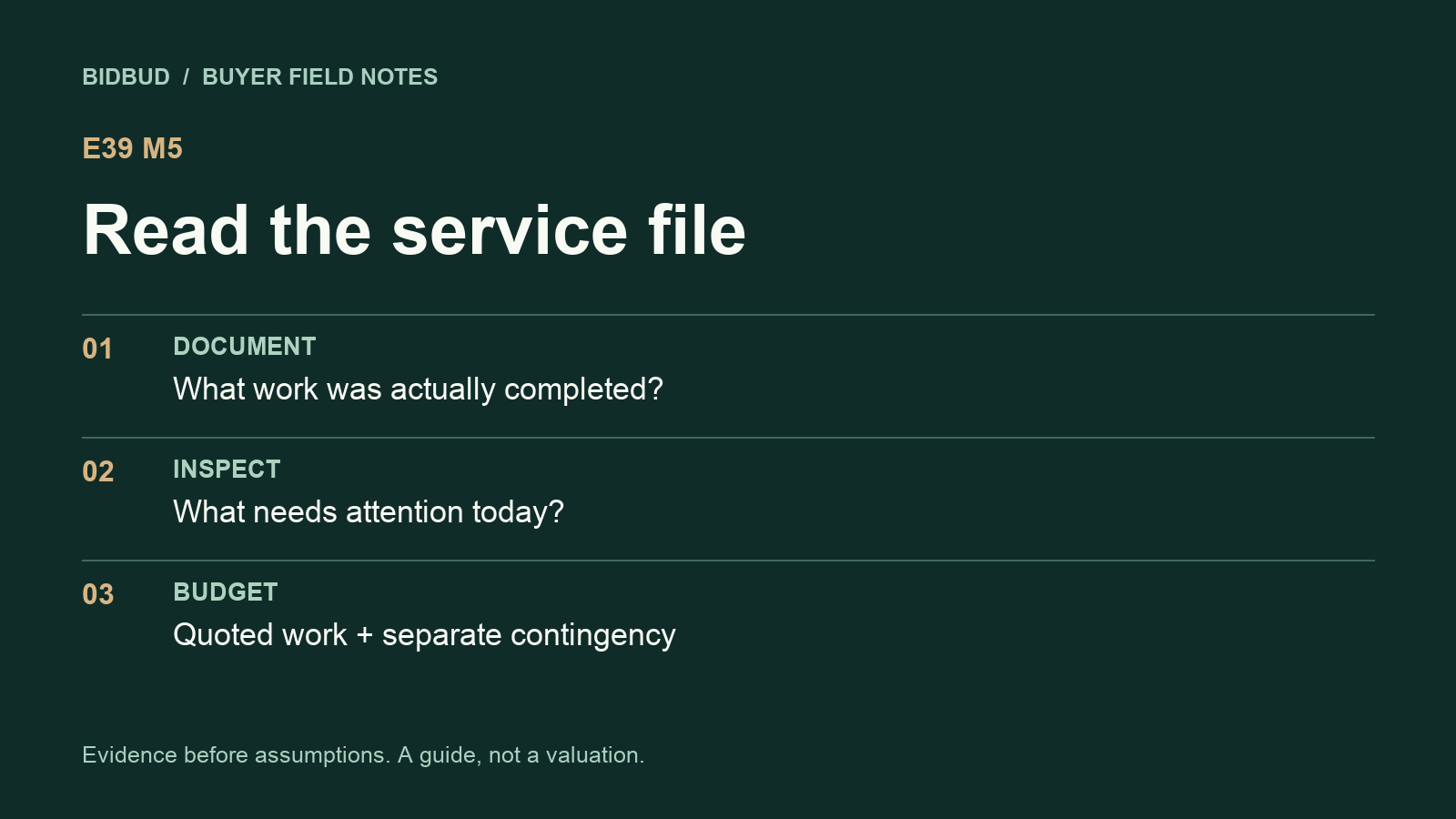
An E39 M5 service file can contain a large past invoice and still leave important questions unanswered. The useful task is to connect each claim to a dated job, distinguish completed work from recommendations, and obtain a present inspection before allocating money for repairs. Neither a missing invoice nor a substantial restoration bill diagnoses the car today.
This guide produces a repair-planning record for one candidate. It does not estimate an E39 M5's market value or prescribe a universal annual maintenance budget.
Keep the inspection specific to the M5
BMW's E39 M5 history describes the model's V8 and double-VANOS system. Its mechanical specification is a reason to use an inspector familiar with the M5, rather than assuming a general 5 Series checklist answers every question.
E39Source's service list includes pre-purchase inspections, engine diagnosis, cooling systems, clutch and flywheel work, suspension and steering, and body and interior work. That breadth helps define an inspection request. A workshop offering a repair does not establish that your candidate needs it, and this list is not a failure-rate study.
Give the inspector the listing and available invoices before the appointment. Ask which areas can be assessed in the agreed inspection, which need additional diagnostic work, and which cannot be assessed without disassembly. Obtain that scope in writing rather than treating “PPI completed” as a guarantee.
Reconstruct the file in date order
For each invoice, record the date, mileage and units, workshop, stated concern, diagnosis, work performed and outstanding recommendations. Distinguish an estimate from a final invoice. A parts purchase alone does not establish installation; a line saying “inspect” does not establish replacement.
Keep ambiguous terms intact until someone explains them. “VANOS done” should lead to a request for the actual scope and parts, not a conclusion that every related component was renewed. “Clutch replaced” should lead to the dated invoice and any separately documented flywheel work. Avoid expanding a short seller description into a larger repair claim.
Track the covered periods as well as the jobs. A folder may document recent ownership well while saying little about an earlier interval. Mark that interval as a history gap. Do not fill it with assumptions about either careful maintenance or neglect.
One documented car illustrates why old work and current needs differ
BaT lot 222764 described a 2002 M5 with service records and several completed jobs, including ignition and cooling-related work. The same listing disclosed missing display pixels, an inoperative rear side shade and an intermittent rear door-lock issue. Completed mechanical work and unresolved convenience faults can coexist.
Use that example to improve the questions you ask, not as an estimate for your car. Listing statements are attributed disclosures, not our independent inspection. Request the invoices supporting the claimed work and ask the inspector to report the current condition of the candidate you intend to buy.
Sort uncertainty before adding a repair reserve
Use three lists, keeping each job in only one list:
- Confirmed work needed: An inspector identifies a current issue and a workshop provides a scoped estimate. Record urgency, parts, labor, tax treatment and any exclusions. Confirm whether the quote overlaps another job.
- Diagnosis still required: A symptom or record gap needs investigation. Budget the proposed diagnostic step separately. Do not quietly turn an unverified possibility into a priced repair or assume the diagnostic charge includes the eventual fix.
- Owner preferences: Cosmetic improvements, optional upgrades or work you want for your intended use. Keep these separate from work required for safe operation.
Ask the workshop to prioritize the first list. Safety-related findings need a professional recommendation about transport and operation, not an internet opinion that the car can be driven home. If a substantial unresolved issue could exceed what you can absorb, declining to bid may be more useful than assigning an arbitrary reserve.
Avoid double-counting and false precision
Your acquisition plan should include the bid, buyer fee and other applicable purchase costs, plus the work you have chosen to fund. Keep an additional contingency visibly separate from quoted work. A contingency is money you decide to retain for uncertainty; it is not evidence that an unknown repair will cost that amount.
For example, suppose a workshop quotes one combined job and separately lists a diagnostic step. Another estimate may include overlapping labor. Before adding them, ask which work is incremental, which is already included and what further approval would be needed. This example describes a reconciliation process, not a current repair price.
Record the quote date and currency, whether parts availability is confirmed, and how long the estimate remains usable. A previous owner's invoice documents a past transaction. It does not lock in your local workshop's future price or establish remaining component life.
Finish with a decision record
Before the auction closes, write down the verified work, the current inspection findings, the unresolved questions and the money you will retain after purchase. Mark assumptions explicitly. Revisit the stopping limit if new evidence changes the funded work; do not raise it simply because the auction is moving quickly.
Our live-auction inspection planning guide explains how to organize access while bidding is open. The BMW research hub collects related buying guides. A useful service file supports a reasoned decision about one car; it cannot eliminate every future repair.