Bring a Trailer auction extensions: how the closing clock works
Bring a Trailer auction extensions: how the closing clock works
By BidBud · October 27, 2026
A Bring a Trailer auction can run past its advertised closing time. The practical question is whether the current countdown has finished after the latest bid, not whether the original appointment on your calendar has passed. Understanding that distinction helps you plan your time and avoid making a rushed decision.
The rule to use at the close
BaT’s official explanation of bidding says its sniping protection extends the clock when a bid arrives in the final moments. Bidding finishes only after two full minutes have passed since the highest bid. A late accepted bid therefore gives other bidders another opportunity to respond.
Think of the deadline as moving with the latest accepted bid during this closing period. Do not add two minutes to the old deadline on your own. Watch the updated auction countdown and bid history. A bid you intend to submit is not the same as one the platform has accepted.
A worked timeline
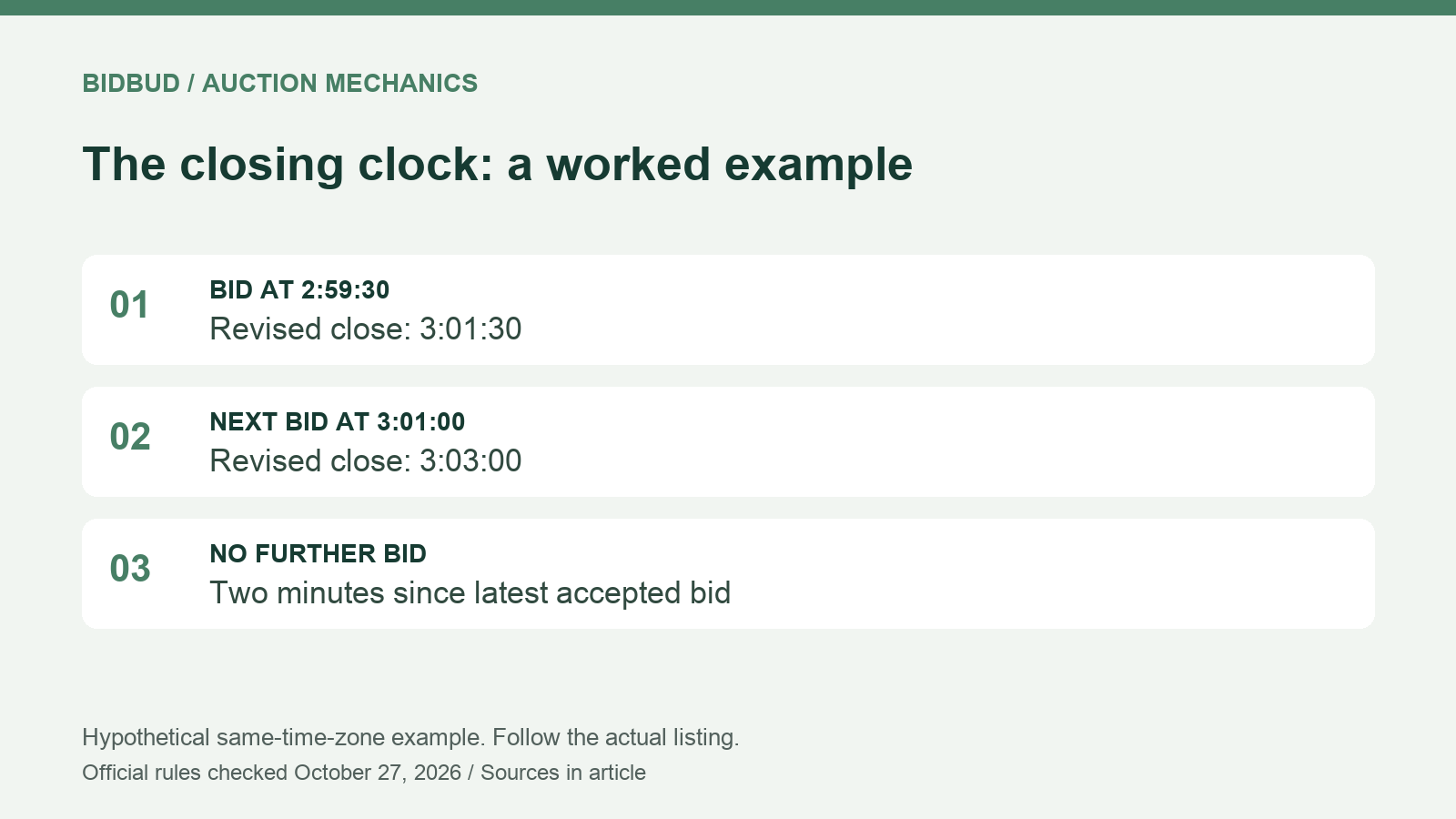
The following is a hypothetical illustration, not an actual auction record. Assume the listing initially shows a 3:00 p.m. close, all times use the same time zone, and each bid described is accepted by the platform.
- 2:59:30: A bid arrives with 30 seconds remaining. Two minutes after that bid is 3:01:30.
- 3:01:00: Another bid arrives before the revised close. Two minutes after this bid is 3:03:00.
- 3:03:00: If there is no further accepted bid, two minutes have elapsed since the latest bid in this example.
The first change adds 90 seconds to the original deadline. It does not move the deadline to 3:02 simply because the phrase “two-minute extension” sounds like two minutes added to the previously scheduled finish. The second bid moves the example’s close again. Your real listing’s displayed state remains the reference; this arithmetic is a way to understand the mechanism, not a substitute timer.
Three states that are easy to confuse
Scheduled close: the time you used to plan attendance. Keep it in your calendar, but allow room afterward rather than promising to leave at that exact minute.
Current countdown: the remaining time shown by the live auction after accepted bidding activity. If the page appears stale or your connection fails, do not assume the old display still describes the auction.
Final outcome: the result recorded after bidding finishes. A finished clock alone does not establish a sold vehicle; reserve conditions are a separate question.
Write those three labels on your auction notes. This separates a scheduling issue from a technical problem and a sale-result question. It also prevents an observer from calling an auction “late” merely because it continued beyond the original close.
A closing-session checklist
- Finish the research first. Resolve the vehicle questions that determine whether you are willing to buy. The extension period is a poor time to start reviewing service history.
- Keep one written ceiling. Record your maximum vehicle price and the additional costs you have allowed. More time on the clock supplies no new reason by itself to increase that ceiling.
- Read the current state. Check the latest accepted bid, the minimum next bid shown by the platform and the countdown before deciding what to do.
- Confirm your own action. After attempting a bid, look for the platform’s confirmation and updated bid history. Do not treat a click or a delayed screen as proof that your bid was accepted.
- Check the result. When bidding has ended, record the outcome separately from the highest displayed amount.
If you cannot establish the current state, avoid repeatedly submitting actions simply to discover whether the first attempt worked. Use the platform’s support route for an unresolved account or bidding problem. An extension rule does not guarantee that a connection problem will be resolved before the sale closes.
What this rule does not tell you
The clock mechanism does not identify an optimal bidding second, predict how many people will respond or establish the car’s value. There is no measured winning strategy in the illustrative timeline. Choosing to stop can still be the right decision while more time remains.
For the broader preparation process, read how to bid on Bring a Trailer. Our buyer-fee guide helps keep the displayed bid separate from acquisition costs. BidBud supports research and personal budget planning; you place any bid yourself.
Rules checked October 27, 2026. Examples and checklist are BidBud’s own explanation. Always use the current listing and platform instructions for an actual auction.