Bring a Trailer credit-card holds: what bidders should expect
Bring a Trailer credit-card holds: what bidders should expect
By BidBud · October 19, 2026
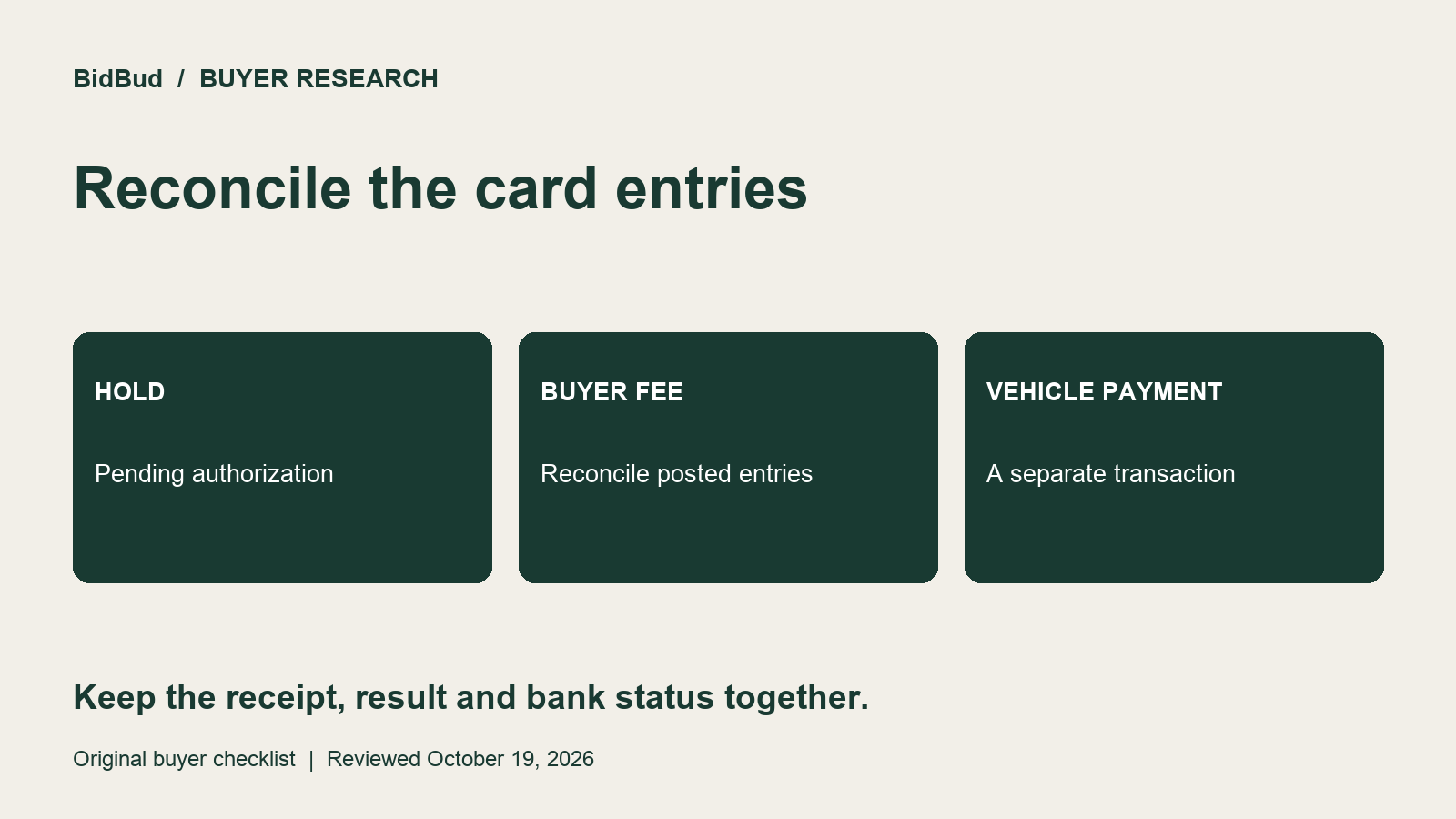
A pending card entry after bidding on Bring a Trailer can be a buyer-fee authorization rather than payment for the vehicle. Keep three amounts separate when reviewing your account: the temporary hold, the final buyer fee, and the vehicle payment.
BaT’s bidding walkthrough explains that it places a hold for the buyer fee when you bid. If you win, that hold becomes a charge; if you do not win, BaT releases it at auction end. Its hold FAQ adds that your bank can take a few days to release the funds.
Reconcile the outcome before adding the entries
Start by identifying whether each bank entry is pending or posted. Keep the listing reference, bidding date, auction outcome, fee receipt and bank entry together. A temporary authorization and a completed charge need different explanations. The visible label in your bank account may not, by itself, tell you the final outcome.
Use this record for each auction:
- Listing reference and currency.
- Initial bid and displayed fee authorization.
- Auction end date and recorded result.
- Final winning bid and buyer fee, if applicable.
- Each pending or posted entry, with its date and amount.
- Any question awaiting clarification from BaT or the card issuer.
This record is for your own reconciliation. Avoid posting card details, bank statements or private payment information in an auction’s public comments.
Why a winner can see two fee charges
BaT’s two-charge FAQ says the initial hold is based on the first bid. If a later winning bid is higher, it can charge the remaining fee difference separately rather than placing a new hold for every bid. Two entries therefore require reconciliation before you conclude that the same fee was collected twice.
Here is a new hypothetical USD example within the 5% fee band. Your first bid is $20,000, producing a $1,000 initial authorization. You later win at $32,000. The total buyer fee is $1,600. Under the FAQ’s described process, the first $1,000 becomes a charge and another $600 accounts for the difference.
$1,000 + $600 = $1,600 total buyer fee. Do not add the initial $1,000 again on top of $1,600. Compare the final posted entries and receipt, and keep any taxes or other separately identified charges distinct. This example does not predict exactly how your issuer will label the transactions.
If you did not win
Separate the platform’s release action from the time it takes your bank to reflect it. Record when the auction ended and what the bank currently shows. Do not assume that a still-visible pending entry is a completed buyer-fee charge or that its continued appearance proves an error.
If an entry remains unexplained, ask BaT to clarify the auction and authorization status, and ask your issuer how it displays and releases that authorization. This guide does not promise a universal number of business days. Keep any response with your reconciliation record.
If the entries do not reconcile
Prepare a short description: “For listing ___, my initial bid was ___ and the recorded outcome was ___. My receipt shows ___, while my bank shows these pending/posted entries: ___.” Send only the information the support channel needs and redact unrelated transactions.
Check whether you are looking at several auctions, a pending authorization alongside a posted fee, or a fee plus another explicitly identified charge. Those are questions to investigate, not assumptions that every discrepancy is harmless. Ask for an explanation rather than guessing from the total alone.
Plan the fee and vehicle payment separately
BaT’s official process overview describes the buyer and seller completing the vehicle transaction after the auction. A fee authorization is not evidence that the vehicle itself has been paid for. Confirm the payment instructions and applicable checkout process independently.
BidBud’s budget worksheet can help organize purchase costs, but it does not inspect your bank account or resolve payment disputes. For the general auction sequence, use our buyer guide.
Research checked October 19, 2026. Amounts above are synthetic examples. Verify current platform instructions and your issuer’s treatment of the specific entries.