Porsche 911 996: Carrera versus Turbo: choosing a comparable cohort
Porsche 911 996: Carrera versus Turbo: choosing a comparable cohort
By BidBud · October 26, 2026
A 996 Carrera and a 996 Turbo can both fit a buyer’s shortlist without belonging in the same price comparison. Start by deciding whether you are comparing substitutes you might enjoy or estimating the purchase range for a particular specification. Those are different questions.
For a Carrera buyer, a Turbo result is useful context about another purchase option. It is not a direct comparable simply because the year, mileage and Porsche 911 badge match. This guide gives you a practical sorting method, including the Carrera 4S case that can make photographs misleading.
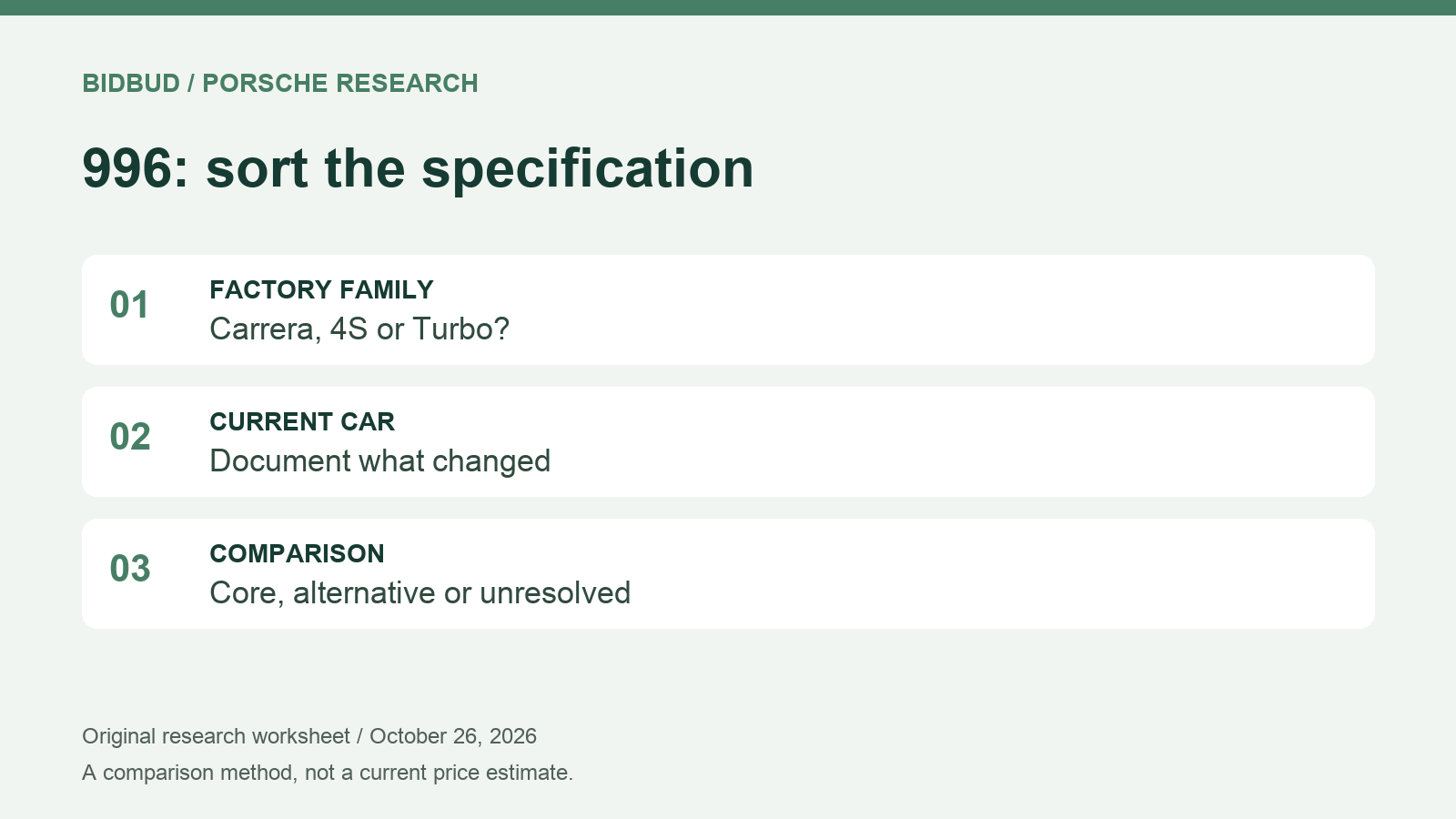
Separate the factory families first
Porsche’s 996 history describes the Carrera’s progression from a 3.4-liter engine to a 3.6-liter engine, while explaining the Turbo’s distinct engine background. Its Classic Turbo reference identifies the production Turbo’s 3.6-liter twin-turbo engine and standard all-wheel drive. A shared displacement therefore does not make the two cars equivalent.
Build the identity line before collecting prices: generation, full variant, body style, sales market, model year, drive layout and gearbox. Obtain the build information or original sales paperwork where available, then compare it with the installed equipment. Keep a replacement engine or changed software on a separate line from factory identity.
Do not describe every naturally aspirated 996 as a Carrera comparable. GT models and special editions need their own identification and matching decisions. Likewise, keep Turbo and Turbo S labels distinct instead of dropping the suffix to increase a small sample.
The Carrera 4S is the useful stress test
Porsche’s Carrera 4 reference describes the 996 Carrera 4S with a body width similar to the Turbo, all-wheel drive and a naturally aspirated 3.6-liter engine. Wide rear bodywork and four-wheel drive do not establish Turbo identity.
For a buyer targeting a Carrera 4S, make that the primary comparison group. A Carrera 4 or Turbo can sit in an alternatives folder, with a clear explanation of the differences. Do not silently combine them and call the resulting average a Carrera 4S value.
If a listing uses “Turbo look,” ask what that phrase means: factory variant, added panels, wheels, or simply a seller’s description. Request evidence of the underlying car and any conversion work. Appearance can direct your questions; it cannot answer all of them.
Use three folders, not one catch-all spreadsheet
- Core comparisons: documented examples of the target variant, body and gearbox, with sufficiently similar condition and a clearly recorded sale context.
- Buying alternatives: other specifications you would genuinely consider. Give each its own budget and inspection brief.
- Unresolved evidence: listings missing identity, configuration or sale-outcome information. Keep them available for follow-up without allowing them to determine the main comparison.
This is an editorial research method, not a statistical valuation model. Record why a listing entered its folder, who supplied the evidence and when you checked it. A later invoice or corrected description may justify moving it; a tempting price alone does not.
Worked sorting example
Suppose your target is a factory-manual 996 Carrera 4S coupe. Consider three hypothetical listings, with no prices implied:
- A documented Carrera 4S manual coupe: a candidate for the core group, pending condition and sale checks.
- A Turbo manual coupe with similar mileage: a buying alternative, because factory variant and engine specification differ.
- A car advertised only as a “996 widebody”: unresolved until the factory identity and modification history are established.
Even the first car is not automatically a completed-sale comparable. Check the closing date, currency and explicit outcome. A reserve-not-met high bid, dealer asking price and completed auction sale must remain separately labeled. Preserve whether any displayed amount includes buyer fees.
Turn the classification into a buying decision
Ask an independent Porsche specialist to inspect the actual target car and quote any work they recommend. Do not apply a Carrera maintenance allowance to a Turbo simply because both are 996s, or treat a factory model guide as evidence of a particular vehicle’s condition.
Your final note should answer two questions: “Does this car match what I intend to buy?” and “Does this result actually support the comparison I am making?” If either answer remains uncertain, show the gap rather than inventing a price adjustment.
Browse the BidBud journal for more auction research. BidBud supports research and personal budget planning; it does not authenticate a car or place bids.
Research checked October 26, 2026. The sorting example is hypothetical. No current valuation, measured Turbo premium or reliability claim is made.