Porsche 911 997: 997.1 versus 997.2 comparable selection
Porsche 911 997: 997.1 versus 997.2 comparable selection
By BidBud · October 26, 2026
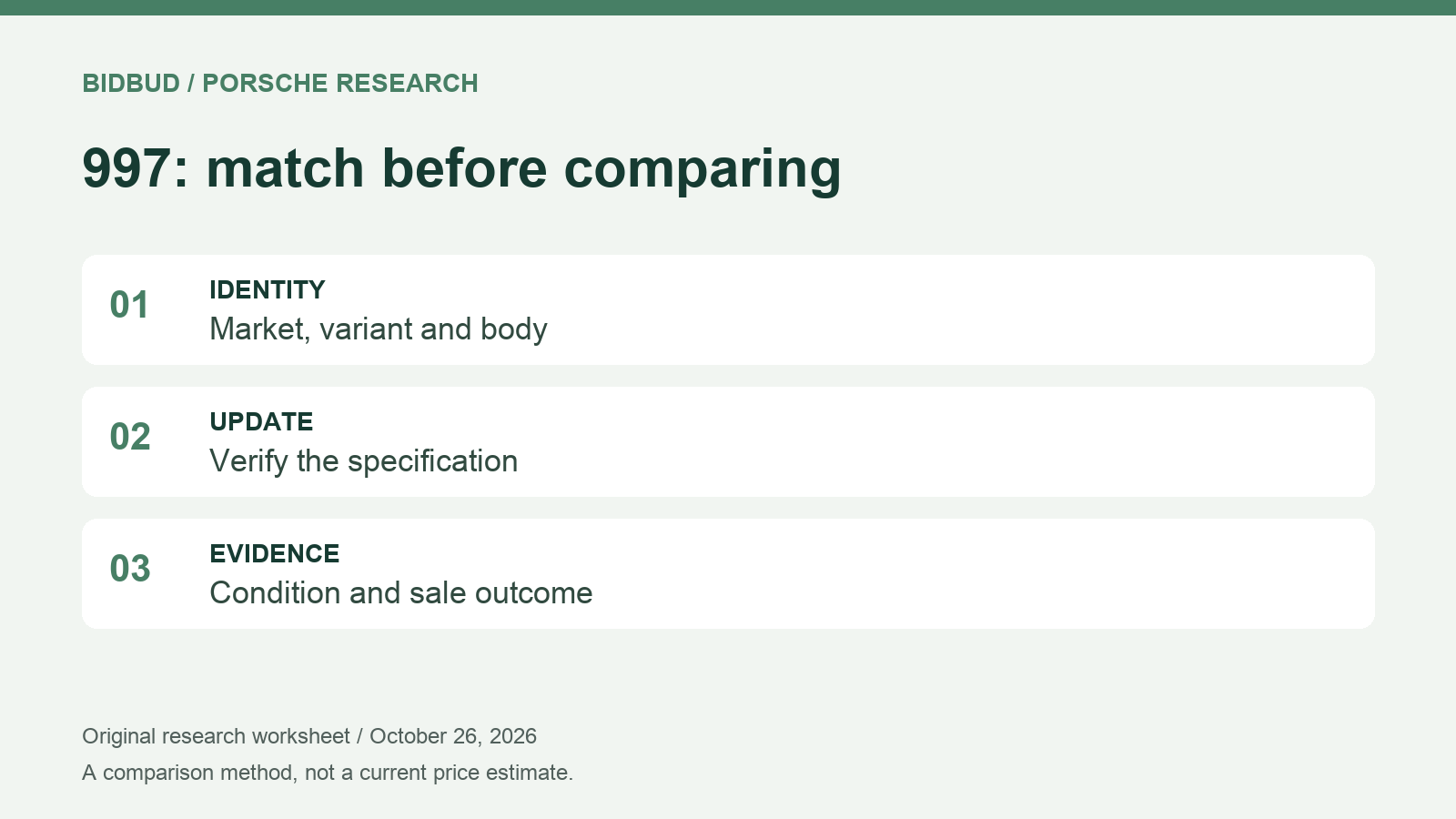
“997.1” and “997.2” are useful search labels, but they are not enough to define a comparable car. For a Carrera search, the update brought important engine and transmission changes. Across the wider 997 family, variant, body, drive layout and model-specific timing still need to be established separately.
Begin with the exact car you want, then use the update label as one field in the record. This guide provides a way to separate missing identity information from genuine buying alternatives, without claiming that every later car deserves a fixed premium.
What Porsche’s history actually establishes
Porsche’s 997 retrospective describes a 2008 model update introducing direct fuel injection, and a range containing many different Carrera, Turbo, GT and special versions. It separately discusses the Turbo’s later engine changes. That is a reason to research the particular model, not apply one blanket changeover rule to every 997.
Its technology timeline records seven-speed PDK’s introduction in the 997 in 2008, initially for Carrera and Carrera S. Distinguish that launch timing from the advertised model year or a first-registration date. An advertisement’s year field may not answer which specification was delivered in its original sales market.
For a car near a changeover, request original build information or sales documentation and compare it with the current engine and transmission description. If a listing supplies only “2008 Porsche 911,” retain an unresolved update field until the evidence supports a more precise classification.
Build an identity line with six fields
Before recording an asking price or auction result, fill in:
- Original sales market and model year. Record production and registration dates separately where available.
- Full variant. Preserve Carrera, Carrera S, Carrera 4, Carrera 4S, Turbo, GT and special-edition distinctions.
- Body configuration. Coupe, Cabriolet and Targa should not disappear into one generic 911 label.
- Update specification. Record the evidence for the advertised early or later configuration, not just the seller’s shorthand.
- Transmission. Keep the specific gearbox description and any replacement or conversion history.
- Current departure from factory specification. Separate software, engine, suspension and appearance changes from original identity.
Use “unknown” when necessary. It is better than converting a probable inference into a fact that later drives a price comparison. A corrected advertisement should prompt an updated record with the supporting evidence retained.
Compare within a group before comparing across it
If your target is a later Carrera S coupe with PDK, begin with documented examples of that specification. Match condition, mileage units, service evidence and significant options before treating their sale results as close references. Earlier Carrera S cars or later base Carreras may be useful alternatives, but they change more than one characteristic of the purchase.
For each auction, preserve the closing date, currency, actual sold or unsold outcome and whether the displayed amount includes fees. Do not combine a dealer asking price with a completed auction result as though both were transactions. Avoid mixing results from different periods without making the date differences explicit.
Only after those fields are reliable should you ask whether the available observations support a comparison between update versions. A larger collection of poorly classified listings does not solve a small-sample problem.
A decision example without invented premiums
Imagine two hypothetical candidates: an earlier Carrera S coupe with a manual gearbox and a later Carrera coupe with PDK. Both may suit your budget and be enjoyable purchase options. They differ in variant, update and transmission, however, so their price difference cannot be described as a “997.2 premium.”
Create a separate comparison group for each candidate. Write what attracts you to each, what documents are missing, and what an independent Porsche specialist needs to assess. If you ultimately choose between them, explain the decision in terms of the two individual cars and your use, not a supposed market adjustment derived from this pair.
For a more controlled update comparison, hold the other major characteristics as consistent as the evidence permits and disclose the remaining differences. If there are too few suitable sales, report that limitation instead of publishing a precise percentage.
Keep condition separate from generation shorthand
An update label is not an inspection result or a reliability guarantee. Request dated service records and an independent inspection appropriate to the exact engine, gearbox and history. Let the specialist define any additional testing and estimate work actually recommended for that car.
Your final worksheet should contain an inclusion reason, an exclusion reason where applicable, and an unresolved-questions column. Those three lines make the research usable: they explain why a result belongs, why another does not, and what evidence could change the decision.
Visit the BidBud journal for more auction research. BidBud supports research and personal budget planning; it does not certify a vehicle or place bids.
Research checked October 26, 2026. The example is hypothetical. This article does not provide current valuations, measured update premiums or failure-rate estimates.