Win on Sunday, sell on Monday
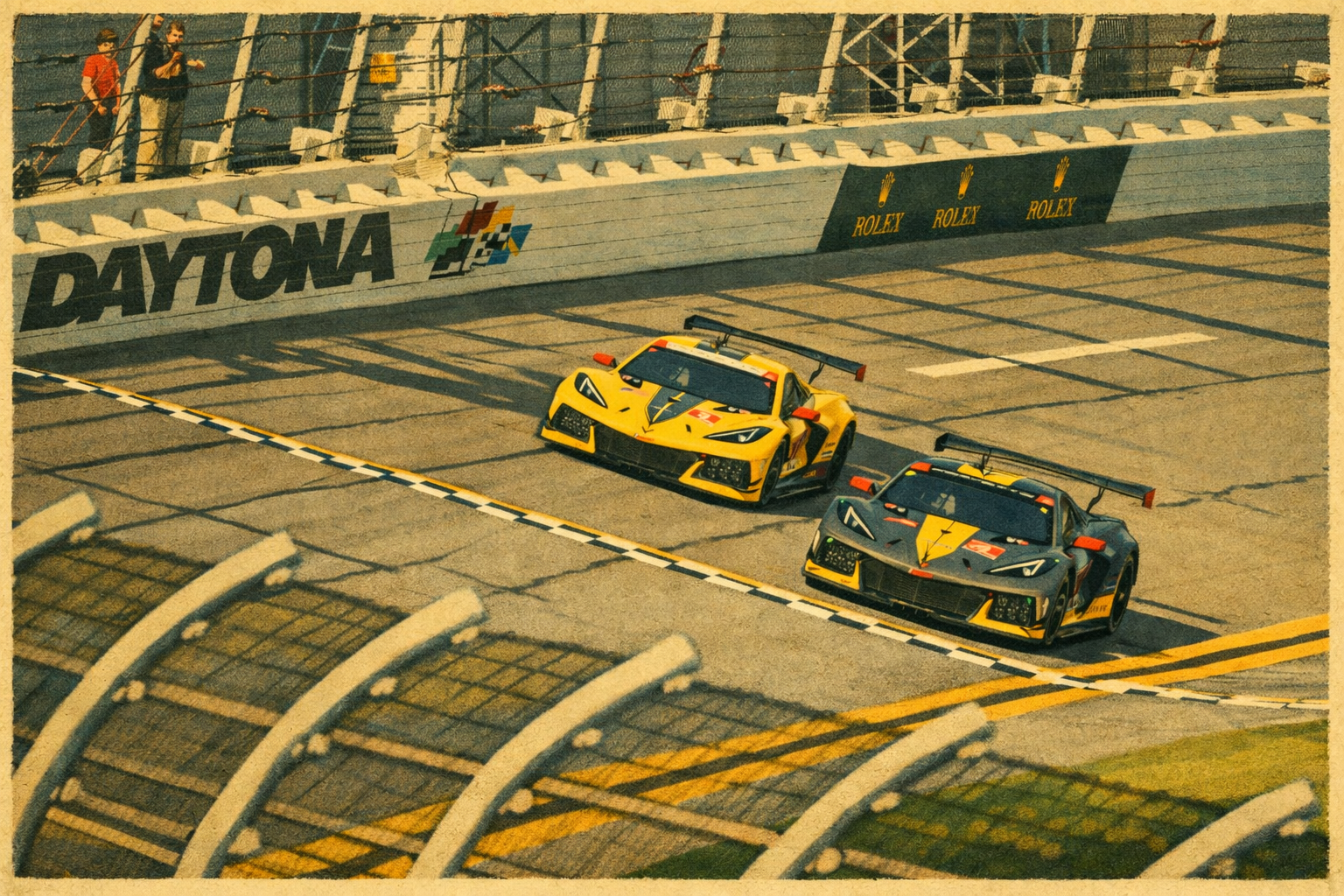
How Endurance Racing Wins Turn Into Auction Premiums
Because platforms like Bring a Trailer, Cars & Bids, and Mecum’s online channels didn’t just move auctions to the internet — they turned cars into high-frequency, narrative-priced assets. Racing success doesn’t merely influence demand. It manufactures equity, especially when the car is rare, properly “connected” to the program, and culturally legible to the buyers who live in comment sections.
And that’s the real shift: motorsport victories now show up in the resale curve.
Two Premiums That Actually Move the Market
Across 2020–early 2026, two mechanisms show up again and again:
1) The Homologation Premium
This is when buyers believe the car is a road-legal extension of the racing program:
- shared architecture,
- shared aero philosophy,
- shared engine “DNA,”
- serious intent.
This premium can create depreciation resistance or outright appreciation.
2) The Livery Multiplier
This is when paint, stripes, heritage colors, and edition branding add 20–30% (sometimes more) because they tell the story in one glance...even when the car is mechanically identical. That sounds irrational until you remember that auctions are emotional.
Case Study: Corvette — Where Racing Credibility Meets Supply Reality
The Corvette story is the perfect example of both the power and the limits of racing correlation.
The C8.R Championship Edition
When Chevrolet dropped the C8.R Championship Edition (1,000 units) after the C8.R’s early success, the market did what markets do: it priced the narrative.
Examples in the early wave showed a clear premium (often ~$12k–$20k) versus comparable Z51 Stingrays — despite no meaningful mechanical difference. The “win” was being bought through story.
But as production volume rose and the C8 became ubiquitous, that premium started to compress. The lesson is brutal and simple: Racing can create a premium but supply can still crush it.
The Z06: Real Engineering Transfer, Real Hype Cycle
The Z06 is the “homologation energy” version of the Corvette story: flat-plane drama, race-adjacent architecture, genuine track intent. Early on, the market rewarded it hard (massive markups, extreme demand).
Then production scaled. Inventory normalized. The curve corrected. The Z06 didn’t become a bad car, it simply became more available.
Case Study: Porsche — The Gold Standard of Motorsport Valuation
If Corvette shows the limits, Porsche shows the ceiling.
Porsche doesn’t just race. It has built a system where racing success continuously underwrites their GT products. The GT3 and GT3 RS aren’t treated like depreciating products... they’re treated like liquid stores of value. So, Why?
Because the market trusts Porsche’s signal. When Porsche says “racing tech,” buyers believe it; and more importantly, they believe the next buyer will believe it.
That trust is creates a feedback loop:
- racing credibility → buyer confidence → resale strength → more confidence → higher premiums
And then Porsche enthusiasts add fuel; to the fire with:
- PTS colors,
- heritage references,
- livery culture.
In online auctions, a heritage-spec Porsche is seen as a story you can drive.
Case Study: Ford — Heritage as a Price Multiplier
The Ford GT is one of the cleanest proofs of “victory financialization.”
The Heritage Editions show how history becomes a measurable price delta. Gulf-style heritage cues have repeatedly acted like an “options package” worth hundreds of thousands compared to a standard example.
That is not engineering value...that’s narrative value.
Ford is now trying to port that logic into the current Mustang era with the GTD.
The Takeaway: Factoring the value of Racing Wins is a valuable Tool
The statement “all race winners appreciate,” isn't true. The way that the market factors in the price of motorsport success is much more selective:
- Homologation-style cars (true road-legal race artifacts) get the strongest correlation.
- Heritage liveries often create disproportionate premiums, even without mechanical changes.
- Mass-market performance cars benefit in brand equity, but still obey supply-and-demand.
- Legend can be worth more than news — historic wins frequently price better than recent ones.
BidBud uses machine learning to do this valuation for you; so you can focus on bidding.