BMW M2 F87: track-use evidence and inspection questions
BMW M2 F87: track-use evidence and inspection questions
By BidBud · November 6, 2026
An F87 M2 with track history needs a better question than “Has it been tracked?” Ask what happened, when it happened, what changed afterward and what an independent inspection finds now. A set of coilovers does not establish an event history. A clean-looking standard car does not establish gentle use. Your job is to connect the seller’s account to records and the car in front of an inspector.
This guide is about assessing use and current condition. Start with our original M2, Competition and CS comparison to identify the variant before choosing comparison cars.
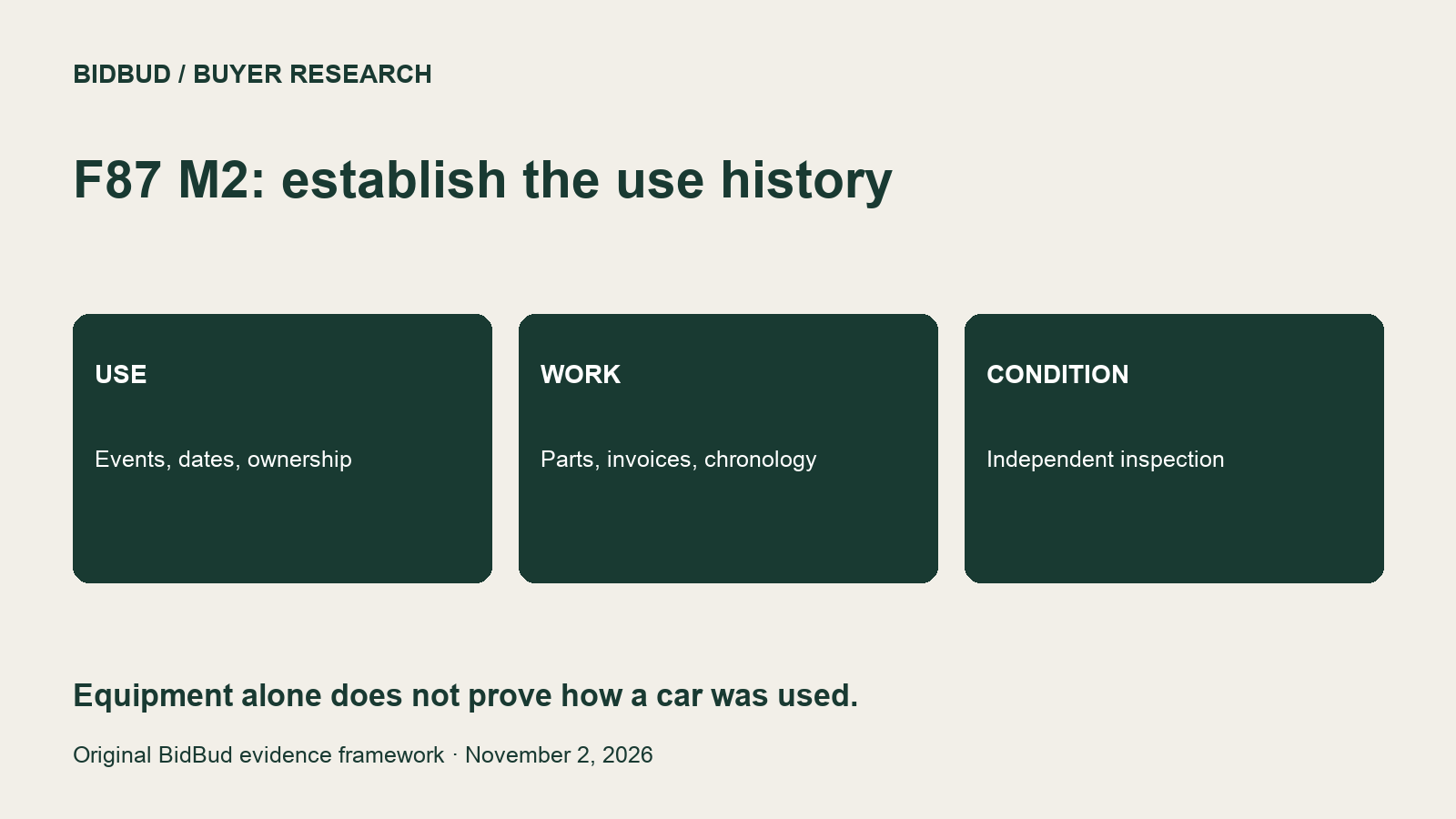
Separate equipment from evidence of use
BMW offered M Performance suspension, exhaust and brake upgrades for the original M2. Its period parts announcement describes adjustable suspension and sports brake pads among those accessories. Their presence can tell you what to investigate, but cannot tell you how often this particular car visited a circuit. Ask for installation invoices and the exact part identification, rather than inferring history from a badge or exhaust mode.
Build a dated use record with four columns: event or period; owner’s description; supporting document; unresolved question. Keep “seller reports no track use during their ownership” separate from “no track use ever.” A later owner may have no reliable knowledge of earlier use.
A real listing shows what a useful paper trail looks like
The 2017 M2 in BaT lot 220297 explicitly described street driving and track events. It also identified Öhlins coilovers, adjustable front camber plates and two-piece brake rotors. The listing dated the camber-plate and rotor installation to April 2022 and described brake-line, fluid and pad work in February 2025.
Those details provide a starting sequence to verify against invoices. They do not establish the remaining life of the components, the quality of the work or the condition today. Nor does a service entry prove that every other area was inspected. This is a documentation example, not a recommendation of that car or a price benchmark.
Request three layers of evidence
Use history: Ask about approximate event dates, sessions, incidents and changes made afterward. Request available event inspection sheets and maintenance records. Invite a precise answer, including what the seller does not know. Avoid turning an unanswered question into an accusation.
Work history: Identify the currently installed brakes, wheels, tires, suspension and any software changes. Ask who fitted them, when, and whether later alignment or repair records exist. Record removed parts separately from fitted parts. A box of original components does not mean the car has already been returned to its original configuration.
Current condition: Arrange an independent inspection by someone familiar with the particular F87 variant and modifications. Give that person the use record and invoices before the appointment, so the inspection can address the actual car rather than a generic checklist.
An inspection request you can send to the workshop
The BMW Car Club of America driving-events manual requires its pre-event inspection to be performed by a qualified person familiar with the vehicle. Its example covers areas such as brakes, tires, wheel bearings, suspension, structure and fluid leaks. That is a useful reminder of the breadth of a physical check. A past event form is not a current purchase inspection or a guarantee of future reliability.
Ask your workshop to provide:
- Dated findings for the installed brake components and tires, including measurements where appropriate and identification of the applicable service limits.
- Findings on wheels, wheel bearings, steering, suspension and visible structural condition, with photographs of anything needing follow-up.
- Identification of visible leaks, undocumented changes or evidence that needs further diagnosis.
- A separate list of immediate work, optional work for your intended use and questions the inspection could not answer.
These are questions for a qualified inspector, not remote diagnoses. Do not substitute a universal internet wear limit for the requirements of the parts actually fitted.
Turn the evidence into a buying decision
Consider two hypothetical listings. Car A discloses circuit use and supplies a sequence of invoices and a recent inspection. Car B looks standard but has an incomplete ownership history and no current inspection. Neither description alone determines which is better. Car A’s records make some uncertainties testable; Car B’s missing information remains missing.
Before bidding, mark each important question as answered, priced into your own repair allowance, or unresolved. If a necessary inspection cannot happen before the close, decide whether you can accept that uncertainty within your existing limit. Do not invent a fixed “track-use discount” or assume modification expenditure becomes resale value. The useful result is a documented decision about one car, not a rule about every M2 that has seen a circuit.