BMW M3 E36: original versus modified examples: building separate comps
BMW M3 E36: original versus modified examples: building separate comps
By BidBud · October 26, 2026
A stock-looking E36 M3 can have a changed engine, software or suspension. A visibly modified car can have a much clearer service record. Before comparing prices, replace the single “original/modified” label with a record of what changed, who documented it and what remains uncertain.
The useful question is whether another car represents the same purchase proposition. This guide offers a modification worksheet and applies it to an actual auction listing. It does not assign a universal modification discount or certify any car as original.
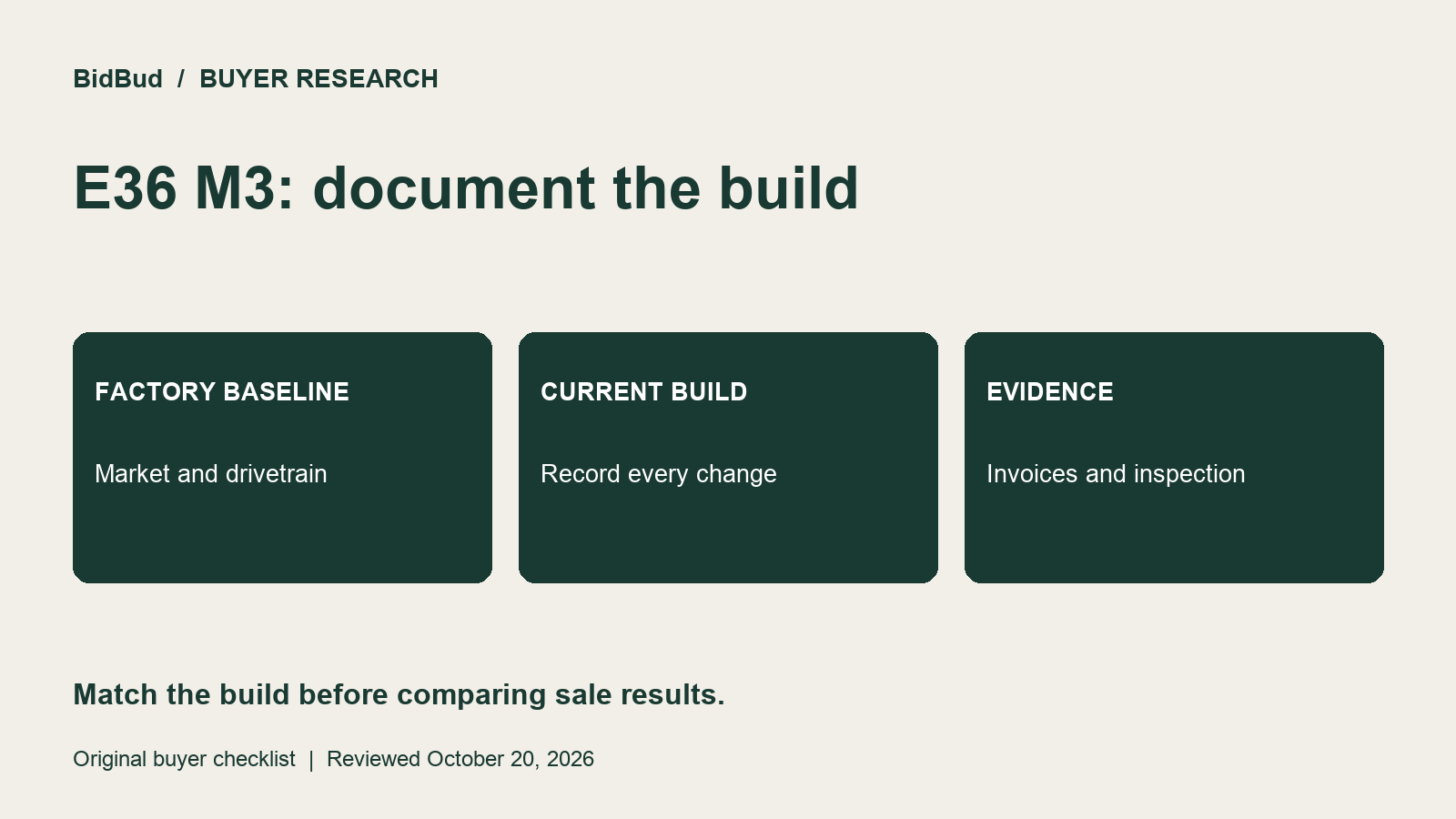
Establish the starting car before judging the build
BMW’s history of the US E36 M3 documents why the US-market car received a different engine specification from its European counterpart. The factory baseline therefore needs a market and model-year context. An engine badge or seller’s shorthand is not enough to establish what the car originally had.
Record the original body, market specification and drivetrain from the available build and ownership records. Keep that baseline separate from the current equipment. Our E36 US-versus-European specification guide covers market identity in more detail; the worksheet below starts after that identity is established.
Give each change its own evidence line
Use five headings instead of one broad modification flag:
- Engine and software: installed engine, induction changes, calibration provider and dated supporting invoices. Ask whether the present calibration matches the present hardware.
- Transmission and driveline: original versus installed gearbox, documented conversion work and any related changes. A manual shifter alone does not prove a factory-manual build.
- Suspension, brakes and wheels: specific components, installation records, setup information and inspection findings. Record maintenance separately from changes in specification.
- Body and cabin: paint work, added panels, seats and removed equipment. Distinguish an appearance change from a documented special-edition identity.
- Reversibility: which removed parts are actually included, their condition and the work needed to restore the desired configuration. “Stock parts included” is a question to verify, not a cost estimate.
For each line, mark the evidence as documented, seller-reported or unresolved. Leave unknowns visible. Do not describe a car as unmodified merely because its listing does not mention changes.
Match the setup to its intended use
In firsthand E36 advice published by Grassroots Motorsports, Bimmerhaus specialist Bob Tunnell recommends choosing spring rates and ride heights with a BMW tuner according to intended use and local roads. The article also contains BimmerWorld’s account of suspension and other upgrades.
That supports a practical inspection question: is this documented setup suitable for the way you will use the car? It does not prove that an upgraded part improves resale value. Ask a qualified inspector to evaluate installation, condition and compatibility. A parts invoice shows a purchase or job; it is not a current inspection report.
Worked example: a supercharged 1997 coupe
BaT lot 226481 describes a 1997 M3 coupe with a supercharged 3.2-liter engine, Dinan-related modifications, changed suspension, steering and seats. Its auction result is explicitly reserve not met.
For a buyer seeking an E36 in factory mechanical specification, that car belongs in a separate modified-build research group. For someone seeking a supercharged E36, it becomes a candidate to investigate, with the installation and calibration records central to the next step. Neither classification establishes the quality of this particular build.
The result also creates an independent exclusion: a reserve-not-met high bid cannot enter a dataset of completed auction sales. Keep the listing as configuration evidence, with its unsold outcome recorded. Do not treat the final visible number as a transaction price.
Build two shortlists with explicit entry rules
Define your target first. One shortlist might require the original type of engine and gearbox, documented maintenance and only specified changes you are willing to accept. A second might admit a particular forced-induction or track-oriented configuration, provided its work is documented and independently inspected.
Within either shortlist, still match body, market, mileage units, condition, sale date, currency and sold outcome. An expensive parts list does not eliminate those differences. Avoid adding modification invoices dollar-for-dollar to a standard car’s value, or subtracting an arbitrary percentage for every modified example.
End each record with one sentence: “Included because …” or “Excluded because …”. If the reason relies on an unresolved fact, keep the car out of the core comparison until that fact is checked. A smaller defensible group is more useful than a larger group whose cars serve different purposes.
Continue with the BMW M3 research hub. BidBud supports auction research and personal budget planning; it does not authenticate modifications or place bids.
Research checked October 26, 2026. Listing facts are attributed descriptions, not an inspection. No numerical valuation or measured modification premium is claimed.