BMW M3 E36: sedan versus coupe versus convertible listings
BMW M3 E36: sedan versus coupe versus convertible listings
By BidBud · October 19, 2026
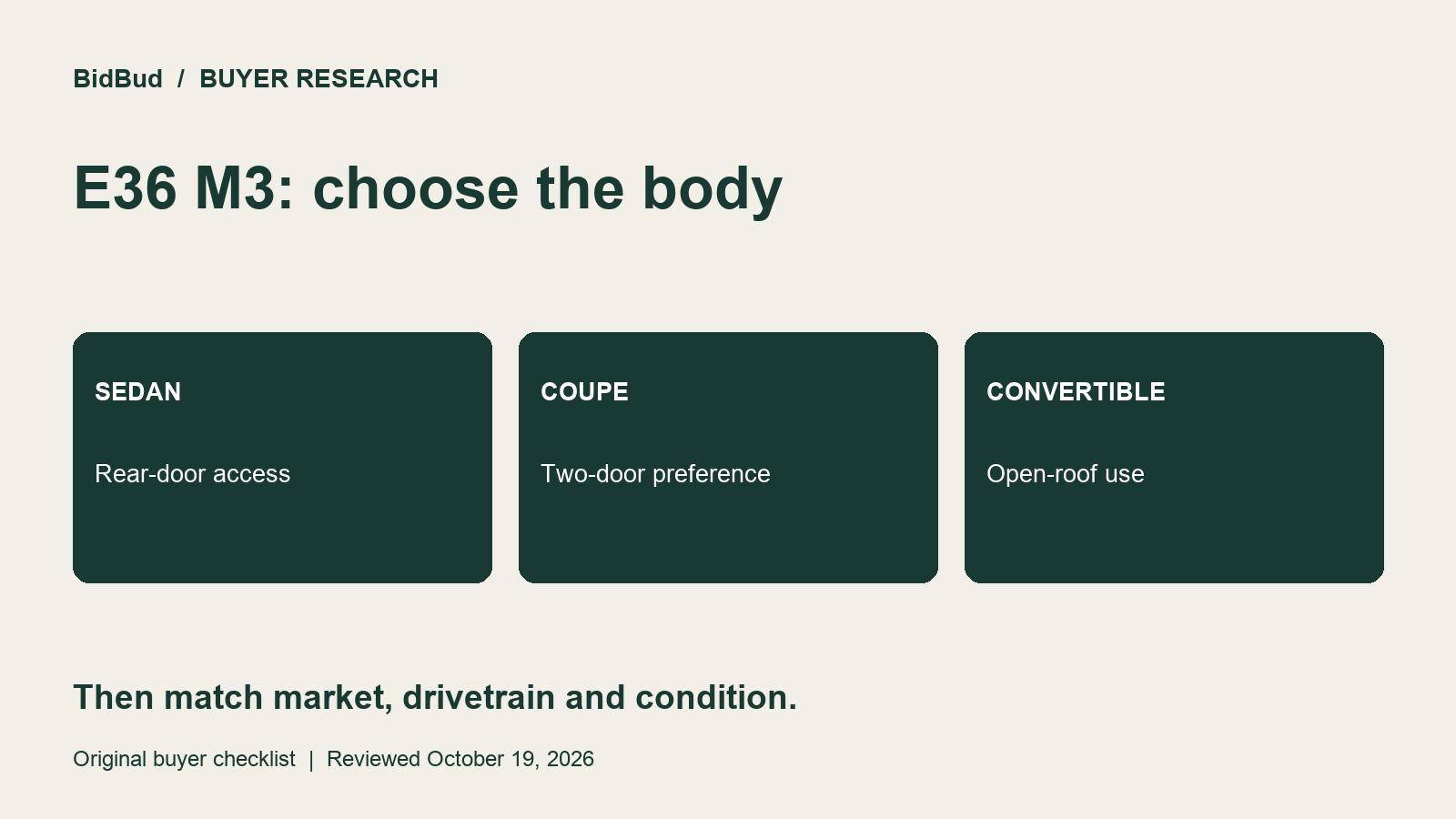
An E36 M3 search can return a coupe, a four-door sedan and a convertible under the same model label. Choose the body style that fits your use before assembling a price comparison. Then match the car’s original market and current drivetrain within that body style.
BMW’s E36 M3 model overview identifies all three production body styles. That establishes the model family; it does not establish that every body and drivetrain combination was offered in every country or model year.
Start with the job you want the car to do
Write down your non-negotiable requirements before looking at asking prices. If regular rear-seat access is important, a sedan is a different purchase proposition from a coupe. If open-roof driving is central to the purchase, evaluate a convertible as that product rather than as an inexpensive substitute for a coupe.
For a useful first pass, record one reason each body style would work for you and one unresolved question:
- Sedan: rear-door access and intended passenger use; check the actual cabin, door and trim condition in the listing.
- Coupe: preference for the two-door body; check whether rear-seat access and the car’s configuration suit your intended use.
- Convertible: intended open-roof use; request evidence of the fitted roof’s operation and condition, including any accessories claimed in the sale.
These are viewing questions, not an inspection diagnosis or a ranking of which version is better. Have a qualified inspector assess condition where it affects your decision.
Do not copy a worldwide timeline into a US listing
BMW’s US E36 M3 Convertible catalog entry describes the US-market convertible separately from the broader model family, including manual and automatic versions. Verify an individual car’s build records, stated model year and original market rather than inferring its specification from a worldwide introduction date.
Keep production date, advertised model year and first registration as different fields. If they appear inconsistent, request the supporting records before assigning the car to a comparison group. This guide deliberately does not turn a production-date range into a universal model-year rule.
Our US-versus-European E36 specification guide covers that separate market-identity question. Here, body style remains the first filter; original market and current drivetrain are subsequent filters.
Build a body-specific evidence sheet
For each listing, save the body style, original market, current engine and gearbox, documented changes, odometer reading and unit, sale date, currency and explicit sold or unsold outcome. Keep a separate column for the evidence supporting the classification.
For a convertible, add the roof configuration and any claimed removable hardtop to your record. Ask whether the included equipment is shown and whether there is a recent operating demonstration. Do not treat a roof-related service receipt as proof that every part of the system currently functions.
For all three bodies, record condition and modifications without assigning an automatic percentage premium or discount. A small comparison group may be the honest result. Broadening it should be an explicit choice with the differences retained, not a way to manufacture a precise average.
A three-listing sorting exercise
Imagine your target is a US-specification manual sedan. You find a sedan with matching documented specification, a manual coupe from the same market, and a convertible with an automatic transmission.
The matching sedan is a candidate for your core group after condition and sale-outcome review. The coupe is a body-style alternative. The convertible differs in both body and transmission, so its price cannot isolate a “convertible discount.” This is a hypothetical classification exercise, not a claim about actual price differences.
If you decide you would equally enjoy the coupe, create a separate buying option with its own budget and evidence. That is more useful than forcing both preferences into one model-wide average.
Treat an “M3 Compact” listing as a separate identity question
BMW M’s E36 M3 Compact history describes its 1996 car as a prototype. That history does not authenticate a privately advertised Compact with an M3 engine or badge as a series-production M3 body variant. Request the original identity and conversion documentation and classify the car accordingly.
Use the BMW M3 research hub to organize generation-level research. BidBud supports research and personal budget planning; it does not authenticate a car or place bids.
Research checked October 19, 2026. BMW Group Classic flags the referenced catalog descriptions as AI-created. They are used only for the broad, attributed model distinctions above; no disputed output, production-count, performance or valuation figures are reproduced. Verify the individual vehicle using its records and an appropriate inspection.