BMW M5 E39: mileage bands: avoiding a one-sale valuation
BMW M5 E39: mileage bands: avoiding a one-sale valuation
By BidBud · Research checked November 26, 2026
A low-mileage E39 M5 auction can be a useful reference without being a price guide for every E39 M5. The question is whether its mileage, history, specification and sale circumstances make it a useful comparison for the car you are considering. This guide provides a way to sort that evidence. It does not calculate a mileage premium or offer a current market valuation.
Define the car before choosing the mileage band
Start with the correct generation and identity. BMW's E39 M5 retrospective identifies it as the first V8-powered M5 and explains that a production automatic or Touring version was not offered. A similarly styled 5 Series, a converted wagon and a later M5 therefore do not belong in the same unqualified comparison group.
Write down your target's market specification, model year, documented mileage and unit, title description, modifications and known condition. Then choose comparison criteria before looking for the highest or lowest result. Starting with an attractive price and inventing the matching criteria afterward makes the comparison hard to defend.
Mileage bands should help organize the search, not conceal information. Retain the actual reported reading beside the band label. Keep an unknown or disputed reading separate rather than putting it into the nearest convenient group.
Two listings show the questions a mileage label leaves open
BaT lot 242794 was a 17k-mile 2003 M5 sold on May 15, 2026. The listing also disclosed tires mounted in 2017, instrument-display pixel irregularities and a previous BaT sale in 2017. Low mileage did not eliminate the need to examine dated records and present condition.
BaT lot 222764 was a 59k-mile 2002 example sold on December 10, 2025. It disclosed aftermarket equipment, cosmetic work and maintenance records. These examples differ in more than mileage and did not sell on the same date. Their results cannot isolate the effect of the odometer.
They are deliberately selected documentation examples, not a representative sample. We have not inspected either car or used these two sales to estimate what another M5 should bring.
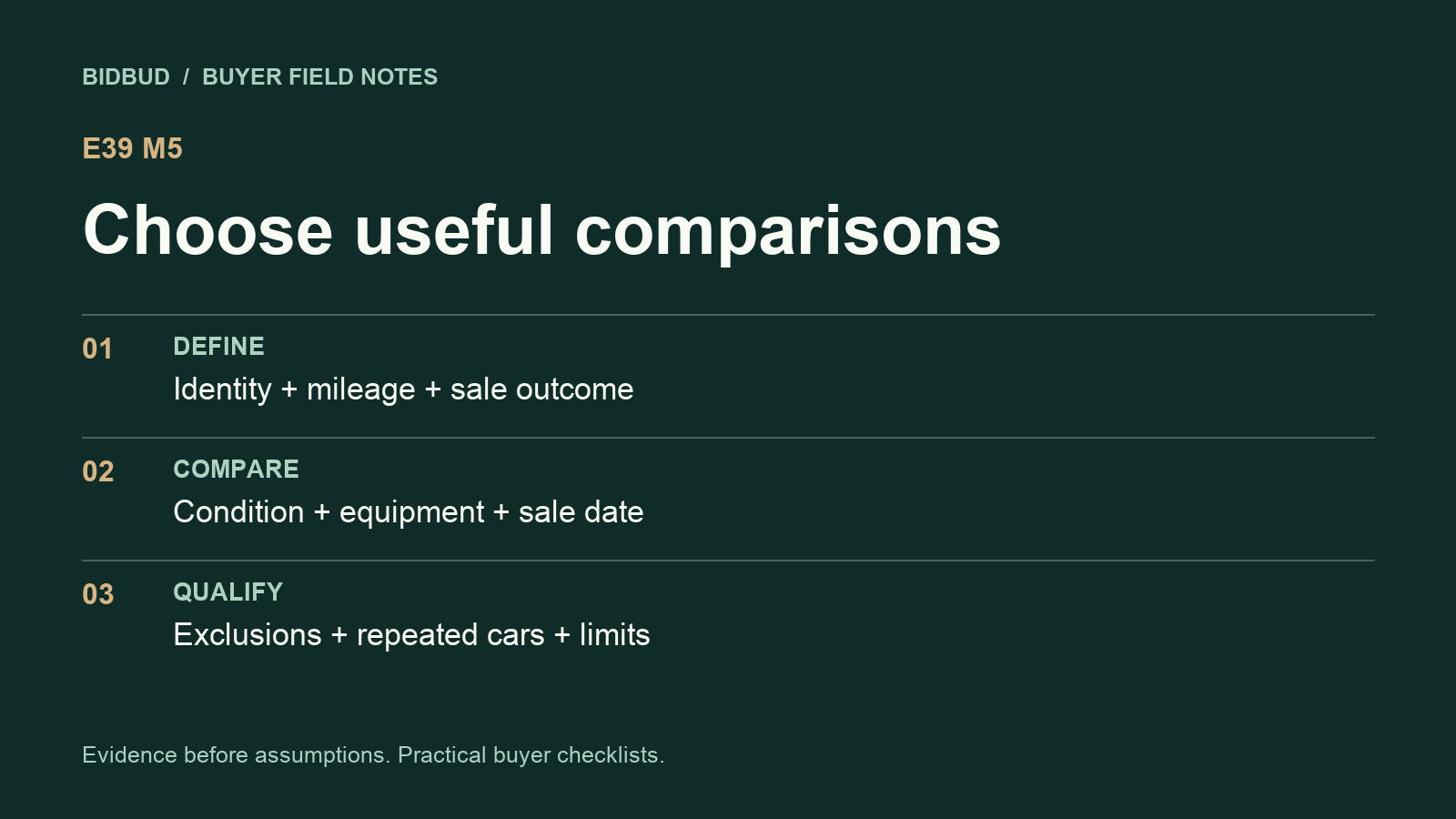
Build one comparison card per auction event
For each candidate, record the following before deciding whether to use it:
- Identity: source link, auction identifier, generation, model year and original market specification.
- Timing and outcome: closing date and whether it actually sold; keep reserve-not-met high bids separate from sale prices.
- Amount: native currency and whether the figure is a winning bid, a fee-inclusive total or an asking price. Do not mix these silently.
- Mileage: reported reading, miles or kilometres, supporting history and any uncertainty or replacement-odometer disclosure.
- Differences: equipment, modifications, title description, finish history, service evidence and material unresolved condition questions.
- Decision: primary comparison, secondary context or excluded, followed by one specific reason.
That last line is the useful output. For example, a well-documented car close to your target may be a primary comparison; a much lower-mileage car with unusual provenance may be secondary context. A listing with an unclear outcome should not enter a sold-price calculation.
Test the boundaries instead of trusting a neat label
Consider a hypothetical target at 50,100 miles and a comparison at 49,900. Putting one in a 50,000–75,000 band and the other below 50,000 does not establish a meaningful condition or price difference. Review the neighbouring group before excluding an otherwise close match.
Conversely, two cars inside the same wide band can have substantially different readings and histories. Keep those differences visible. If a conclusion changes when one borderline car moves groups, describe the evidence as sensitive to the grouping rather than announcing a reliable premium.
When suitable examples are scarce, expand one criterion at a time and label the compromise: older sale date, different market specification or a wider mileage range. Do not broaden everything at once and continue calling the resulting group closely comparable.
Separate repeated cars and current condition
The earlier sale linked in lot 242794 illustrates a second bookkeeping issue: auction events and unique vehicles are different counts. Two appearances can be relevant to a repeat-sale study, but they are not two independent cars. Record that relationship before counting your evidence.
For condition questions, commission a suitably scoped inspection. E39Source lists pre-purchase inspections, engine diagnostics, cooling, suspension and clutch work among its services. That supports seeking model-specific expertise; it does not diagnose a fault or establish a replacement interval for your target.
Use the E39 service-history and repair-reserve guide to evaluate the records separately. Your final note should say which comparisons are useful, why others were excluded and what remains uncertain. A documented comparison set is a stronger starting point than turning one memorable auction into a universal valuation.