Jeep Cherokee Chief: History and the 2026 Market
Jeep Cherokee Chief: History and the 2026 Market
By BidBud · November 6, 2026
The Jeep Cherokee Chief makes a strong first impression: broad shoulders, prominent graphics and the proportions of a full-size American four-wheel drive. Buying one well takes a closer look. Trim identity, body condition, mechanical changes and restoration documentation all deserve attention before the bidding starts.
Recent auction results offer useful reference points, but they describe several different kinds of vehicle. A modified Cherokee S, a wide-track Chief with deferred work and a bespoke V10 restomod should not share one valuation. Here is how the Chief fits into Jeep history, what selected 2026 results tell us, and where Italian specialist MrWagoneer fits into the restoration picture.
Where the Cherokee Chief fits in Jeep history
The original SJ Cherokee arrived in 1974 as a Wagoneer-derived model aimed at a younger audience seeking family transport and recreational capability. It initially had two doors; a four-door version followed in 1977. The SJ generation continued through 1983 before the smaller XJ Cherokee arrived for 1984. Stellantis Cherokee history
The Chief brought a more assertive identity to that family in the mid-1970s. Jeep’s retrospective describes its Wide-Track package with larger wheel openings, wider axles, larger wheels, exterior stripes and Dana 44 axles front and rear. Those changes help explain why the Chief remains visually distinct from a narrower-bodied SJ. Jeep’s 1970s history
For buyers, the important distinction is between the Cherokee model family and the specific trim or equipment package. “SJ Cherokee” and “Cherokee Chief” should not be treated as interchangeable descriptions. An S or Laredo can provide useful context when studying the broader market, but it needs to retain its own identity in the comparison.
Start with the vehicle’s documentation and specification rather than the graphics. Replacement decals and a fresh finish may suit a truck beautifully without establishing its original configuration.
The blue Cherokee that did not meet reserve
The recent blue example was a 1977 Jeep Cherokee S 4x4, not a Chief. Bring a Trailer recorded a $27,000 high bid with reserve not met on October 18, 2026, after 19 bids. Blue 1977 Cherokee S auction
Its listing described ownership since 1978, a blue repaint, replacement graphics and a reupholstered blue interior. According to the seller, an AMC 401 had been enlarged to 407 cubic inches, while the TH400 automatic and Quadra-Trac transfer case had been rebuilt. The five-digit odometer showed 29,000 miles, which should not be read as verified total mileage. Vehicle description and disclosures
The result records bidding activity and an unmet reserve, rather than a completed transaction. It does not reveal the seller’s minimum, establish a subsequent sale or explain why bidding stopped. For a prospective buyer, the useful question is whether the mechanical work and overall condition justify their own all-in budget. Restoration spending alone cannot establish what another bidder should pay.
For the platform’s next steps after an unsuccessful auction, see our reserve-not-met process guide.
Selected 2026 Cherokee auction results
These public results show why close reading matters. Amounts are in US dollars and represent platform-reported winning bids before buyer fees, except for the clearly marked unsuccessful auction. They are not independently audited settlement confirmations. S and Laredo examples provide context for the SJ family rather than direct Chief valuations.
1980 Cherokee Chief
January 27, 2026 · Sold for $11,250. No reserve; 360 V8 and automatic; disclosed transmission-fluid leak.
1975 Cherokee S
July 17, 2026 · Sold for $22,500. No reserve; replacement long block; rocker-panel rust repairs; 64,000 miles shown.
1981 Cherokee Laredo
October 14, 2026 · Sold for $20,500. Frame and right-rear-quarter rust disclosed; air conditioning inoperative; odometer had rolled over.
1977 Cherokee S
October 18, 2026 · $27,000 high bid, reserve not met. Modified engine; no completed auction sale.
Vigilante 1979 Cherokee Chief
June 18, 2026 · Sold for $315,000. Bespoke restomod with a 9.0-liter Prefix Viper V10, six-speed manual and custom Roadster Shop chassis.
The Vigilante build belongs in a separate comparison group. Its extensive engineering and specification make the sale relevant to buyers considering bespoke restomods, but a poor benchmark for a largely standard Chief. Including it in a simple average would obscure the differences that buyers actually need to evaluate.
What the current market evidence can tell buyers
This small, deliberately varied sample cannot establish a market median or demonstrate appreciation or depreciation. It does illustrate the danger of shopping by model name and headline price alone. A lower purchase price accompanied by corrosion or mechanical faults creates a different ownership proposition from a more expensive vehicle with documented work.
Build a shortlist of genuinely comparable trucks. Match trim and body configuration first, then consider originality, drivetrain, corrosion, restoration scope and the quality of supporting records. A modified engine may be attractive to someone seeking performance and less useful to someone prioritizing factory specification. Neither preference makes the other buyer’s valuation wrong.
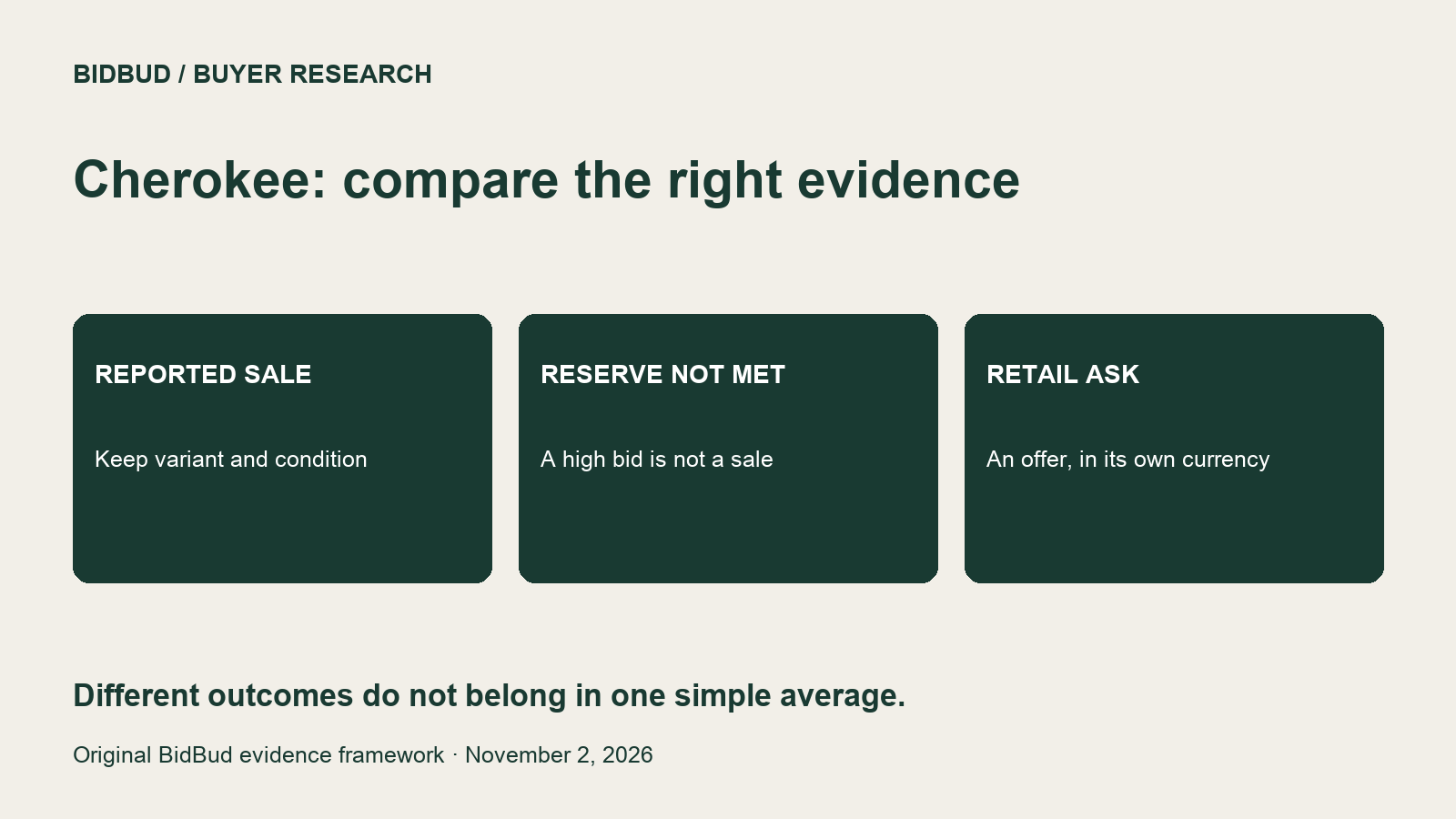
Auction format also belongs in the analysis. A no-reserve auction has no reserve threshold for the winning bid to clear; a reserve-not-met result leaves a gap between bidding and the seller’s threshold. Keep reported sales and unsuccessful auctions separate when assembling your own reference sheet.
Assess the individual Jeep, and use recent results to test your reasoning. These examples do not support a universal “correct price” for a Cherokee Chief. Our GT3 RS auction case review applies the same discipline to another model: retain each vehicle’s specification and final outcome instead of averaging unlike results.
MrWagoneer and Cherokee restoration in Italy
MrWagoneer offers another perspective on the SJ’s appeal. Based in Capannori near Lucca in Tuscany, the business identifies Matteo as its driving force and Massimiliano as its workshop lead. Its focus includes the restoration of full-size Jeeps. MrWagoneer team
The company describes three offering levels: As It Is, Refresh and Frame Off. Its published restoration menu covers areas including engines, cooling and fuel systems, wiring, brakes, transmissions, transfer cases, paint and interiors. These are the company’s descriptions of its services, rather than an independent assessment of workmanship. A buyer should obtain a vehicle-specific scope of work instead of assuming that a tier name answers every question. MrWagoneer restoration services
Two advertised Chiefs show how varied that inventory can be. A red 1982 example was listed at €55,700, with a preserved original interior, engine work, a 4.5-inch lift and 33-inch tires. Its combination of preservation and modification is worth noting when deciding what “restored” means for your intended use. Red 1982 Chief listing
A blue 1979 Jeep, described in the listing copy as a Chief, was advertised at €22,600 in the As It Is category. The listing described a 5.9-liter engine, automatic transmission, engine restoration in 2021 and upholstery previously redone by an earlier owner. That history should not be presented as work necessarily performed by MrWagoneer. Blue 1979 Chief listing
Both amounts are retail asking prices checked on November 6, 2026, not verified sale results. They are also euro-denominated offers in a different location from the dollar auction examples. Comparing them requires attention to condition, included work and the buyer’s transport and ownership costs, rather than a simple currency conversion. These listings illustrate the specialist’s offering; their inclusion is not an endorsement.
What to check before bidding on a Cherokee Chief
A useful inspection should answer specific questions rather than simply label a vehicle “good” or “restored.” Prioritize the following:
- Identity and configuration. Check the VIN, available factory documentation and equipment against the description. Record changes rather than assuming every visible feature is original.
- Structure and corrosion. Arrange an independent inspection of the frame, rockers, floors and rear quarters. Ask for evidence of earlier repairs, including photographs taken before fresh paint or undercoating.
- Drivetrain work. Request invoices and specifications for rebuilds or modifications. Have the engine, transmission and four-wheel-drive system checked, including any disclosed leaks or operating faults.
- Restoration evidence. Review dated photographs and itemized invoices. Establish what was replaced, repaired or left untouched, and who performed the work.
- Mileage and total cost. Separate odometer readings from documented mileage. Set a budget that includes fees, transport, inspection and the repairs identified before purchase.
The Cherokee Chief rewards a buyer who enjoys its appearance enough to investigate what lies beneath it. Its history supplies the appeal; the individual truck’s evidence should decide the bid. Keep the blue S’s unsuccessful auction, ordinary SJ sales and ambitious custom builds in their proper categories, and the market becomes much easier to read.