Porsche Mission S: how it could reshape the 911 auction market
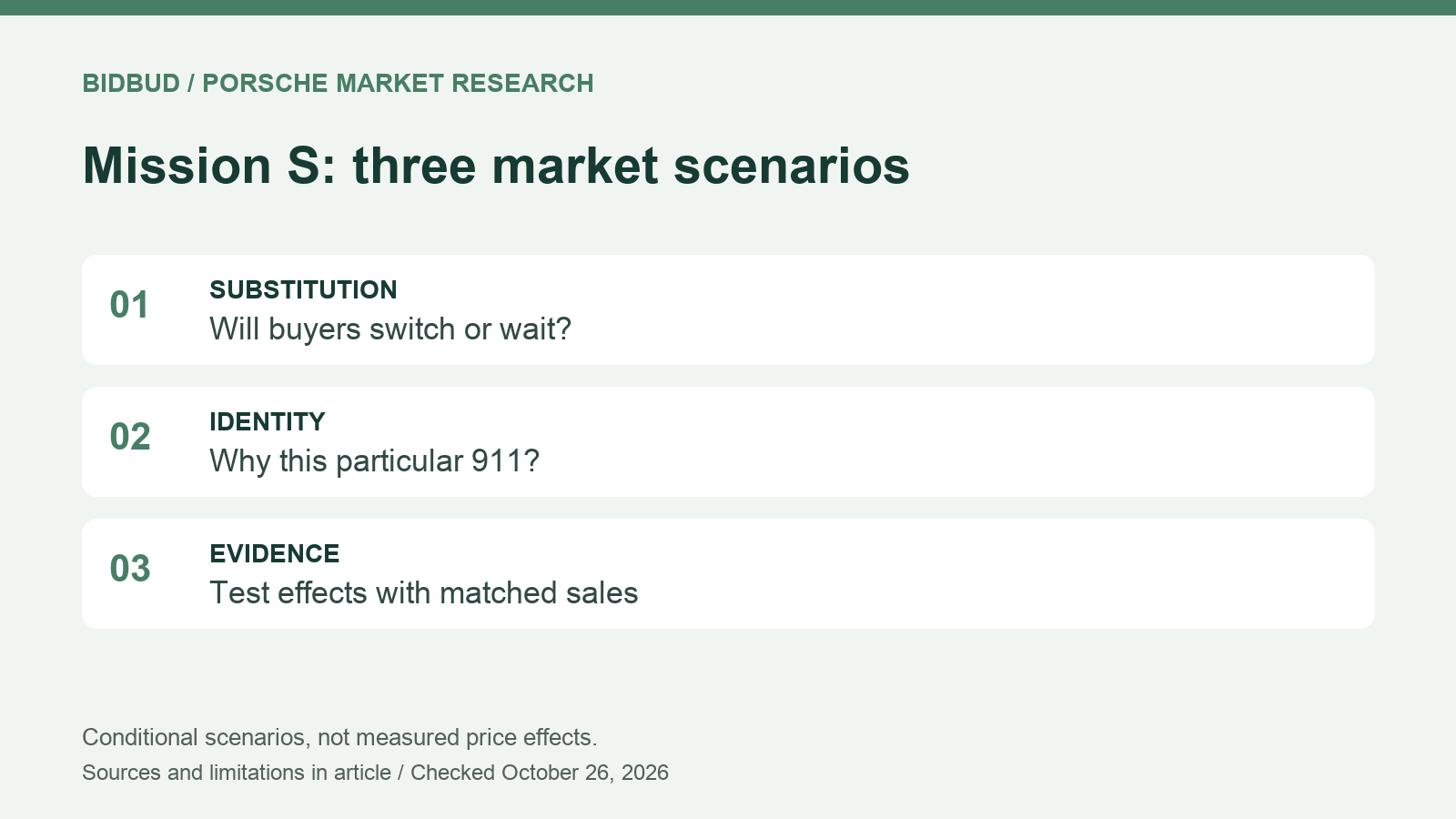
Porsche Mission S: how it could reshape the 911 auction market
By BidBud · October 26, 2026
Porsche’s Mission S could change the choices facing a high-end 911 buyer. It does not yet establish a new price for the car in that buyer’s garage. The most useful auction-market question is which buyers might switch, which might stay, and what evidence would distinguish a lasting change from excitement around a reveal.
Our assessment is that Mission S has a plausible path to reshaping the top of the 911 market through buyer substitution and stronger distinctions between different kinds of Porsche. That is an editorial scenario, not an observed price effect or a forecast of returns. A track-focused GT3 RS, a manual enthusiast’s 911 and an older collectible should not be assigned the same response.
What Porsche has actually announced
Porsche unveiled Mission S on October 15, 2026. Its official announcement describes a vision model and a new mid-engine super sports car platform positioned above the 911, intended as a permanent addition rather than a one-off hypercar. That positioning matters: the announcement does not describe Mission S as a replacement for the 911.
The concept also emphasizes driver interaction, physical controls and a central tachometer with an analogue needle. Porsche’s Mission S overview presents this as a direction for the brand’s design. These are concept attributes, not a guarantee of every feature on a future customer car.
The announcement reviewed for this article does not establish a customer delivery date, production price or final powertrain specification. An auction analysis that assumes a particular engine, allocation volume or transaction price would be starting with unverified inputs.
Three ways the 911 auction market could respond
1. A new alternative for the top-end buyer. If the eventual production car competes for the same discretionary budget as an expensive 911, some shoppers may delay a purchase or move to the new model. This possibility is most relevant to buyers who want Porsche’s newest performance offering. It is less directly relevant to someone seeking a particular historic 911 or a specific driving experience.
The counterargument is access. A higher price, long delivery wait or different intended use could leave the two cars serving different customers. Positioning above the 911 alone does not prove substitution. Watch confirmed production specifications and actual availability before translating this scenario into a lower bid limit.
2. A clearer reason to own a particular 911. A new mid-engine product could make the identity of an existing 911 more explicit. A buyer may want that car’s generation, layout, gearbox, history or character regardless of what Porsche introduces next. The useful question becomes “Why this 911?” rather than “Is it still Porsche’s newest headline car?”
That can support differentiation without proving appreciation. Provenance, condition and the number of genuinely comparable cars still matter. A seller’s claim that every existing 911 will become more collectible is not an auction result.
3. A test of the analogue-experience story. Mission S highlights direct controls and driver involvement. One interpretation is that Porsche is validating qualities enthusiasts seek in older cars. Another is that a future car could offer some of those qualities without the compromises of an older vehicle. These mechanisms point in different directions. Neither establishes a universal manual-transmission premium or makes a PDK-equipped GT3 RS obsolete.
The GT3 RS is a useful test, but not the whole 911 market
A track-oriented buyer may judge the eventual Mission S by sustained circuit capability, consumables, support and usability. A collector may care more about specification, mileage and originality. Those buyers can compete for the same GT3 RS today while reacting differently to a new model tomorrow.
Our proposed test is therefore segmented. Track ordinary-mileage, documented-use examples separately from near-delivery-mileage cars. Preserve Weissach equipment, brake specification, original sales market, modifications and repair history. Compare sold results with sold results, while reporting unsold auctions separately. An increase in unsold listings could reflect seller reserve choices as well as weaker buyer demand.
What would count as evidence of a Mission S effect?
Use October 15 as an announcement marker, then allow enough observations on both sides of it. Record auction closing dates, final outcomes and any later negotiated result. Keep native currencies and fee treatment consistent. Deduplicate repeat listings and identify repeat sales of the same car before treating them as independent observations.
Then ask whether changes remain after matching specification, mileage, condition and sale venue. Compare with a relevant broader enthusiast-car segment to test whether the movement is Porsche-specific. A single strong sale, a failed reserve or a change in asking prices cannot isolate the announcement’s effect. Even a matched before-and-after comparison would establish association before it established causation.
BidBud’s local comparable-sales snapshot checked for this article ends on February 22, 2026. It predates the reveal and cannot measure its impact. We have therefore not presented that snapshot as post-announcement evidence, calculated a Mission S premium, or supplied a target price.
A practical decision for buyers and sellers
Buyers can write down what they want from the actual car: track use, touring, a particular gearbox or collection significance. If the reason depends mainly on owning the newest Porsche flagship, waiting for firmer Mission S information may change the decision. If the reason is a specific existing 911, inspect that car and compare it with its true peers.
Sellers should explain documented specification and condition rather than add an unsupported “future classic” surcharge. For older cars, our 997 comparison guide shows how to keep generations and variants distinct. BidBud supports auction research and personal budget planning; it does not place bids.
Research checked October 26, 2026. Market mechanisms above are BidBud’s analysis of possible outcomes. No measured Mission S effect, production commitment beyond the cited announcement, or guaranteed future value is claimed.