From Niche to Multi-Billion Dollar Market: The Rise of Online Enthusiast Car Auctions
From Niche to Multi-Billion Dollar Market: The Rise of Online Enthusiast Car Auctions
Not that long ago, an “online car auction” was a fuzzy eBay listing, three photos, and a leap of faith. If you wanted a trustworthy vehicle, you went to a convention center and hoped to be the highest bidder. Today, you can sit on your couch, scroll through hundreds of high-res photos, read a full service history, and watch six people fight over a car in real time. The enthusiast car auction has gone from forum curiosity to a meaningful slice of the global used-car economy in about a decade.
This post looks at how big that market has actually become, how it compares to traditional dealer and wholesale channels ,and why the data from all those Bring a Trailer, Cars & Bids, and PCar-style listings is rocket fuel for software tools like BidBud.
THE SETUP: FROM COTTAGE INDUSTRY TO REAL MONEY
Enthusiast platforms started like digital cars-and-coffee events—tight communities, inside jokes, and a handful of listings. The difference is that these communities sit on top of modern payments, title, and escrow infrastructure. Once the formula clicked—good curation, transparent comments, and reasonable fees— the volume followed.
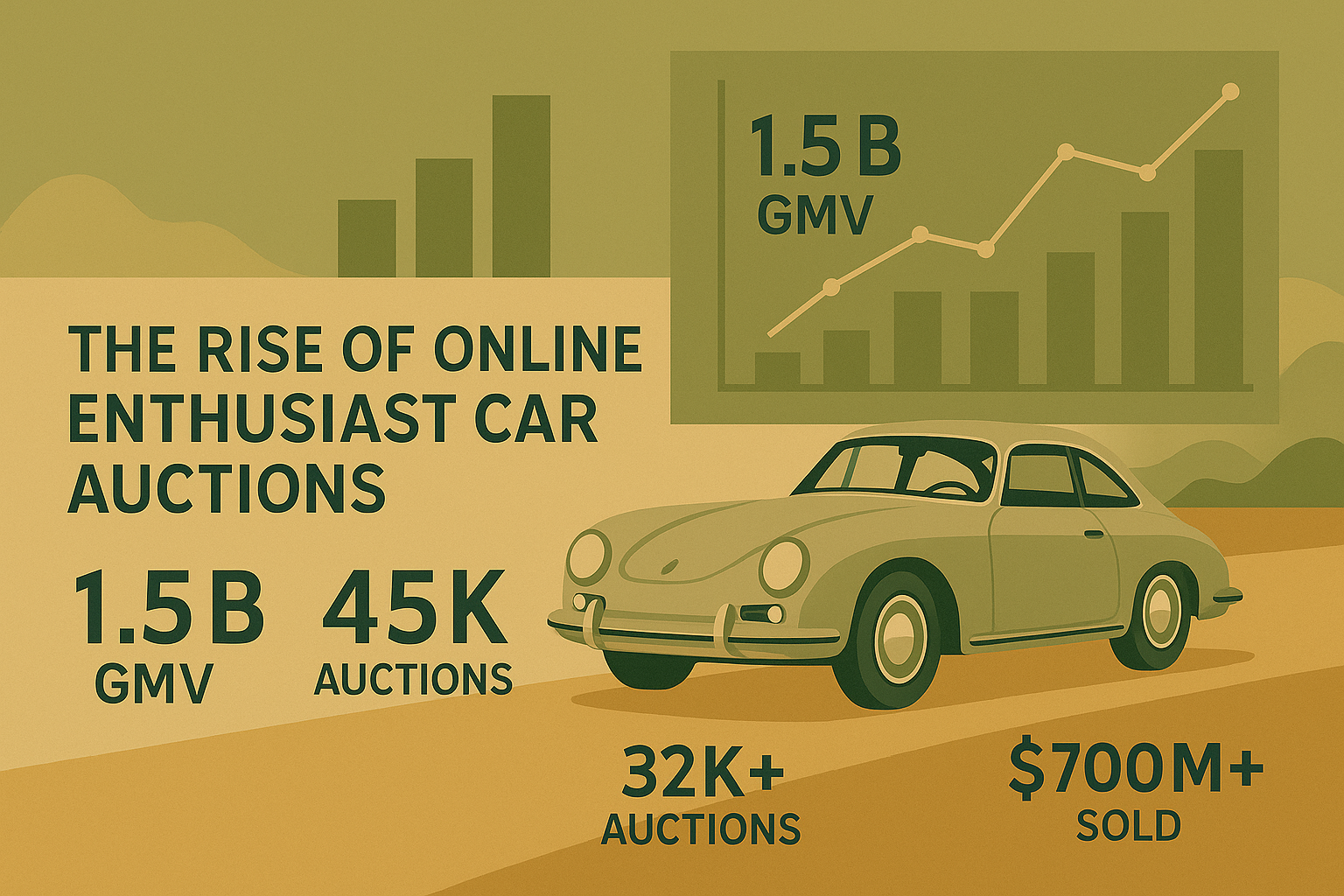
Bring a Trailer is the clearest example. In 2023, BaT sold more than 30,000 cars, up roughly 19% from 2022. By 2024, the platform was handling about 45,000 auctions a year across cars, trucks, bikes, and memorabilia and closing roughly $1.5 billion in sales, its third straight year above the $1-billion mark.
Cars & Bids, focused on newer enthusiast vehicles, has quietly built its own slice: more than 32,000 auctions completed and over $700 million in car value sold, with a self-acclaimed sell-through rate north of 80%. Add in specialist sites like PCarMarket, and online arms of traditional players, and the enthusiast corner of the online auction world is now solidly a multi-billion-dollar category in its own right.
THE NUMBERS: HOW BIG IS THIS, REALLY?
Step back to the wider auction landscape. One research firm pegs the broader online car auction market—which includes dealer, fleet, and salvage alongside enthusiast platforms—at just under $5 billion in 2024, with expectations to triple to around $15 billion by 2035 on double-digit annual growth. Another report estimates the overall U.S. vehicle auction market at about $3.5 billion in 2024 and roughly 14 million units passing through the lanes.
Those numbers sound big until you compare them to the rest of the used-car universe. Globally, the used car market is on the order of $1.9 trillion in 2024, climbing toward $2.7 trillion by the end of the decade. In the U.S. alone, one analysis puts the used-car market around $1.05 trillion in 2025, with more than 37 million used vehicles changing hands in 2024.
Enthusiast auctions are still a relatively small slice of the total used-car pie—but they punch far above their weight in terms of data, transparency, and cultural influence.
WHERE BIDBUD FITS IN
In our Seller's Reports, we treat pricing as an instrument panel you can read and tune, not a mystery you guess at. The same philosophy applies to the market itself.
BidBud sits on top of enthusiast auction data and does three big things:
· Market sizing at the segment level
Instead of saying “the 911 market is up,” BidBud looks at how much capital is actually flowing through specific trims, generations, and conditions over rolling windows. That lets you see, for example, whether 997.2 Carrera S stick-cars are cooling while GT3s hold, or whether Land Cruiser 100s have quietly become six-figure trucks.
· Price discovery with context
BidBud doesn’t just quote past hammer prices; it evaluates how strong or weak those results were relative to bid volume, comment sentiment, reserve behavior, and macro conditions. A soft close in a thin week looks different than a similar price achieved in a bidding war.
· Pattern recognition for buyers, sellers, and platforms
With enough history, you can spot how close-times, listing quality, and platform choice affect outcomes. Sellers can pick better venues and timing; buyers can recognize when something is actually cheap vs. just under the last crazy comp; platforms can see where their catalog is thin or oversaturated.
WHY IT MATTERS NOW
The broader used-car market is huge and noisy. Interest rates, macro headlines, and OEM incentives swing monthly payment shoppers back and forth between new and used. Enthusiast auctions are different. They’re where discretionary dollars, passion, and scarcity collide—and where the same car might appear multiple times over a few years as it moves between garages.
Because these platforms are still a small share of total volume, every decision matters more. A wave of new bidders, a fee change, or a tweak to how reserve listings are promoted can move millions of dollars of GMV in a year. For collectors and enthusiasts, it’s where real price discovery is happening in public. For dealers and auction houses, it’s the canary in the coal mine for what the next generation of buyers actually cares about.
THE LONG ROAD AHEAD
The next decade won’t just be about “more auctions” or “bigger prices.” It’ll be about intelligence layered on top of them:
· Platforms using AI to pre-screen listings, flag discrepancies, and suggest reserve bands.
· Bidders getting real-time feedback on where a car sits relative to fair value and end-game dynamics.
· Sellers using tools like BidBud to choose the right platform, timing, and presentation for their specific car—not just their gut.
· Auction houses themselves licensing data and analytics to improve match rates, reduce instances of “reserve not met,” and keep buyers engaged.
The rise of online enthusiast auctions is a story about data—high-signal, enthusiast-driven, deeply contextual data that lets us finally model how people value the machines they love. BidBud’s goal is simple: turn that data into something you can actually use, whether you’re listing your first Miata or managing inventory across thousands of VINs.
From here on out, the most dangerous phrase in the enthusiast market is, “I’m just going with my gut.” The opportunities are too big—and the data is too good—not to bring a smarter copilot along.